Booch News

In November 2018 I launched a new blog.

Booch News is the premier source for independent news about all aspects of the kombucha industry — the beverage that is taking the world by storm.

It offers an in-depth look into the kombucha industry,  discusses the latest trends, marketing techniques, news, profiles, and other topics related to kombucha.

I’ll still post occasional updates to Professionally Speaking, but most of my attention these days is on Booch News. Meanwhile, the 900+ posts and 100+ podcast interviews on this site will remain as an archive of useful information.

AI for Leadership Communication

I was intrigued to read that the Professional Speechwriters Association is promoting a workshop titled ‘AI for Leadership Communication‘ taught by speechwriter Brent Kerrigan. The course promises:

…[a] course with one goal in mind: to help leadership communication professionals gain a hands-on, practical, shirtsleeve understanding of AI’s role in our work and how to use it ethically, effectively and strategically.

We’ll tailor it to your organization’s needs—the technology you use, the skillsets your team possesses and the communication problems you’re trying to solve, for the leaders you work for every day.

Together, you and your team will come away AI-aligned, with a toolbox of prompts and approaches that you can apply immediately to strengthen your research, enhance your messaging, drill down on fact-checking and refine your communication strategies. You will learn how to use generative AI, make the leap into agentic AI, and understand the (important) difference. Just as important, you’ll see how AI can help boost your value as individuals and as a team—by making you faster, more adaptive and more confident in the services you provide.

You’ll all return to your work less ambivalent about AI and more enthusiastic—clearer-minded about how it can help and how it can’t, and confident in your own ability to make AI work: for organization and its leaders, and the communicators they rely on.

Brent offers four 90-minute webinars tailored for beginners, priced at a flat $15K, plus an additional $1K for every participant over 15. This might work in the corporate world and certainly represents fair value for organizations that want a seasoned pro to guide them in what, for some, is the overwhelming and rapidly changing world of generative AI. And it is especially valuable since Brent promises to tailor it for each group.

Generating Coursework

I took Brent’s description of the first session in the series and fed it into Claude:

PROMPT: Act as a instructional designer. Create an outline of a course for corporate communications professionals titled ‘Generative AI in Speechwriting and Other Leadership Communications (Research, Structure and Composition)’ Include a non-technical explanation of what AI is—and isn’t—as far as communicators are concerned. Then focus on using AI to support the early and middle stages of the writing process. Begin with foundational generative AI techniques and strategic prompt development, give the essential skills to build better workflows, conduct fast and thorough speech research, and turn briefing notes into clear building blocks for speech drafts.

The result was a much more elaborate curriculum than would fit into a 90-minute webinar. Nevertheless, it is a useful framework for those not flush enough to pay Brent’s fees, showing how speechwriters willing to do some self-paced learning can engage with AI.

Claude’s response

Start of Claude generated content >>>>

Course Outline

Generative AI in Speechwriting and Other Leadership Communications

Research, Structure and Composition

Audience: Corporate communications professionals, speechwriters, executive communications teams Format: Instructor-led or self-directed modular learning Estimated Duration: 6 modules / ~9–11 hours of instruction + exercises


Course Philosophy

This course treats generative AI as a thinking partner and process accelerator, not a ghostwriter. The skills taught here are designed to make communicators faster, more thorough, and better prepared — while keeping human judgment, voice, and craft firmly in charge. The focus is on the early and middle stages of the writing process: research, discovery, framing, structure, and drafting building blocks.


Module 1 | What AI Actually Is — A Communicator’s Orientation

Duration: ~90 minutes Purpose: Build an accurate, non-technical mental model of generative AI so communicators can use it with confidence and appropriate skepticism.

1.1 Stripping Away the Hype

  • Why the public narrative about AI confuses more than it clarifies
  • What “generative” actually means: pattern, prediction, and language
  • The difference between AI generating text and AI knowing something
  • Why AI has no intentions, no experience, and no memory of your last session

1.2 What Generative AI Is, for a Communicator

  • A fast, tireless language processor with vast pattern exposure
  • A useful first-draft engine, brainstorming partner, and structural scaffold
  • A tool that reflects what you give it — quality in, quality out
  • An accelerant for the parts of writing that are slow, repetitive, or paralyzing

1.3 What Generative AI Is Not

  • Not a researcher: it does not retrieve live, verified facts
  • Not a strategist: it cannot assess organizational politics or stakeholder nuance
  • Not a voice: it defaults to generic unless you teach it otherwise
  • Not infallible: hallucination, overconfidence, and flatness are real risks

1.4 The Communicator’s Compact with AI

  • You are the editor, not the typist
  • AI raises a first floor; your craft builds the rest
  • Accountability for accuracy, voice, and appropriateness remains entirely yours
  • Introducing the concept of the human-in-the-loop workflow

1.5 A Quick Look at the Tools Landscape

  • Overview of major platforms (ChatGPT, Claude, Gemini, Copilot) without technical deep-dives
  • Key differences relevant to communicators: context windows, memory, file handling
  • Security and confidentiality basics: what not to put in a prompt
  • Practical guidance on tool selection for your organization

Module 2 | Prompt Development as a Professional Skill

Duration: ~2 hours Purpose: Establish strategic prompting as a core, learnable competency — the communicator’s primary interface with AI.

2.1 Why Prompting Is Not Just Asking Questions

  • The prompt as a creative brief: specificity determines output quality
  • How AI interprets vague instructions — and why the results feel generic
  • The prompting mindset: directing, not requesting

2.2 Anatomy of an Effective Prompt

  • Role: Assigning context and perspective (“You are an experienced speechwriter working for a Fortune 500 CFO…”)
  • Task: Stating what you need with precision
  • Constraints: Length, tone, audience, format, what to avoid
  • Output format: Bullet points, prose, structured outline, table — specify it
  • Examples: Using sample language to anchor the style you want

2.3 Core Prompting Techniques for Communicators

  • Zero-shot, few-shot, and example-anchored prompting
  • Chain-of-thought prompting: asking AI to reason step-by-step before producing output
  • Persona prompting: establishing audience perspective to pressure-test content
  • Iterative refinement: treating the first response as a draft, not a deliverable
  • Constraint prompting: using restrictions to sharpen focus (“Do not include statistics. Avoid jargon. Write at an 8th-grade reading level.”)

2.4 Prompts for the Writing Process Specifically

  • Prompts for generating questions you haven’t thought to ask
  • Prompts for identifying gaps in an argument
  • Prompts for exploring alternative framings of a message
  • Prompts for tone calibration and register adjustment

2.5 Building a Personal Prompt Library

  • Why saving and iterating on prompts is a professional asset
  • Organizing prompts by task type: research, structure, drafting, editing
  • Prompt templates for recurring communications tasks (earnings remarks, town halls, external keynotes)
  • Workshop: Participants build their first five reusable prompt templates

Module 3 | Establishing AI-Assisted Workflows

Duration: ~90 minutes Purpose: Map the writing process clearly and identify where AI creates the most leverage — and where human judgment is non-negotiable.

3.1 Mapping the Communications Writing Process

  • A clear stage-by-stage model: Discovery → Research → Framing → Structure → Drafting → Refinement → Delivery Prep
  • Where most communicators lose time and why
  • Introducing the concept of AI handoff points: where you bring AI in and where you take back control

3.2 Designing Your Workflow Before You Start Writing

  • Why beginning without a plan produces mediocre AI output
  • The pre-prompt checklist: what you need to know before you type a prompt
  • Aligning your workflow to the type of communication (internal vs. external, scripted vs. extemporaneous, technical vs. inspirational)

3.3 Collaboration and Oversight in AI-Assisted Work

  • Working within team environments: version control, transparency, attribution norms
  • Communicating AI involvement to stakeholders (when and how to disclose)
  • Establishing your organization’s guardrails for AI use in sensitive communications

3.4 Common Workflow Failures — and How to Avoid Them

  • Accepting first-draft AI output without critical review
  • Feeding AI too little context and expecting nuanced results
  • Over-relying on AI for voice — and why executive communications is especially vulnerable
  • Workflow exercise: Participants diagram a current project and identify three AI integration points

Module 4 | AI-Powered Research for Speeches and Leadership Communications

Duration: ~2 hours Purpose: Teach communicators to use AI to accelerate, organize, and deepen the research phase — while understanding its factual limitations.

4.1 The Research Challenge in Executive Communications

  • Why speech research is different from academic or journalistic research
  • The communicator’s research goals: context, credibility, narrative material, and audience insight
  • Time pressure and the risk of under-researched speeches

4.2 Using AI to Generate Research Frameworks

  • Prompting AI to produce a research agenda for a given topic and audience
  • Using AI to surface angles, sub-topics, and lines of inquiry you might not have considered
  • Asking AI to identify likely audience knowledge gaps, objections, or skepticism points
  • Generating a “what do I need to know before I write this” checklist

4.3 Background Research and Context-Building

  • Using AI to synthesize background on an industry, company, policy area, or issue
  • Building a fast-briefing document from AI-generated summaries (with verification steps)
  • Prompting for historical context, relevant precedents, and analogy material
  • The verification imperative: every AI-generated fact must be confirmed with a primary source

4.4 Audience Research and Stakeholder Analysis

  • Prompting AI to help profile an audience: likely concerns, priorities, cultural context
  • Using AI to stress-test a message from the perspective of a skeptical audience member
  • Building empathy maps and listener profiles using AI as a thinking partner
  • Identifying language that resonates vs. language that alienates for a given group

4.5 Researching the Speaker

  • Using AI to help synthesize information from speaker bios, prior speeches, and interviews
  • Prompting for voice and style patterns from provided text samples
  • Building a speaker profile document that informs drafting and maintains consistency
  • Research lab: Participants use AI to produce a structured research brief for a sample speech assignment

Module 5 | From Briefing Notes to Building Blocks: Structuring the Draft

Duration: ~2 hours Purpose: Teach communicators to use AI to transform raw input — briefing notes, bullet points, background materials — into organized structural foundations for a speech or communication.

5.1 What a Briefing Note Is and What It Needs to Become

  • The typical content of a briefing note: facts, context, objectives, key messages, tone direction
  • The gap between a briefing note and a speech: narrative, flow, voice, emotional architecture
  • The structural translation problem — and how AI helps bridge it

5.2 Feeding AI Your Source Material Effectively

  • How to prepare and format briefing notes for AI input
  • Providing context AI cannot infer: organizational culture, speaker personality, audience relationship
  • Using the briefing note as a constraint document, not just a content source
  • What to withhold from AI input for security and confidentiality reasons

5.3 AI-Assisted Message Architecture

  • Prompting AI to extract and prioritize key messages from a briefing
  • Using AI to identify the single most important idea in a body of content
  • Generating a message hierarchy: primary message, supporting points, proof points
  • Stress-testing message clarity: prompting AI to summarize in one sentence, then evaluating alignment

5.4 Building Speech Structures with AI

  • Classic structural frameworks and when to use them (Problem–Solution, Past–Present–Future, Challenge–Response–Vision, The Narrative Arc)
  • Prompting AI to propose multiple structural options for the same content
  • Using AI to generate section headings and signpost language
  • Mapping content from the briefing to structural slots — AI as an organizational sorter

5.5 Turning Structure into Draft Building Blocks

  • The concept of the modular draft: discrete, replaceable units of content
  • Prompting AI to develop individual sections — openings, transitions, proof points, closes — as separable building blocks
  • Using AI to generate multiple versions of the same section for comparison
  • The communicator’s role at this stage: curator and architect, not transcriptionist

5.6 Evaluating AI-Generated Structure

  • What good structure feels like vs. what AI tends to produce (competent but flat)
  • Identifying where AI has imposed a generic logic that doesn’t fit your speaker or audience
  • Annotating and revising AI structure before moving to full drafting
  • Practical exercise: Participants receive a sample briefing note and use AI to produce a fully annotated structural draft

Module 6 | Putting It Together — Applied Practice and Professional Judgment

Duration: ~90 minutes Purpose: Consolidate skills through an end-to-end applied exercise and establish a framework for ongoing, responsible AI use.

6.1 End-to-End Workflow Simulation

  • Participants work through a realistic scenario: a 10-minute town hall address for a fictional executive
  • Using AI at each stage: research brief → audience profile → message architecture → structural outline → draft building blocks
  • Individual or team debrief: where did AI accelerate the work? Where did it fall short?

6.2 Recognizing and Fixing Common AI Output Failures

  • The five most common problems in AI-generated communications content: vagueness, over-explanation, tonal flatness, unearned emotion, and structural conventionality
  • Editing strategies for each failure type
  • When to regenerate vs. when to edit

6.3 Developing Your AI Judgment as a Professional

  • How to know when AI is helping vs. when it’s anchoring you to mediocrity
  • Building critical distance from AI output — the 30-minute rule
  • Continuing to develop your craft alongside your AI fluency

6.4 Looking Ahead: What’s Next in AI for Communicators

  • Emerging capabilities relevant to communications professionals (multimodal input, real-time research integration, longer context windows)
  • What is unlikely to change: the need for human voice, judgment, and relational intelligence
  • Staying current without chasing every new tool

6.5 Course Wrap-Up and Personal Action Planning

  • Each participant articulates three workflow changes they will implement immediately
  • Building a 30-day AI integration plan
  • Recommended resources for continued learning

Course Appendices

Appendix A — Master Prompt Library (30 starter prompts organized by workflow stage)

Appendix B — The Communicator’s AI Verification Checklist (fact-checking protocol for AI-assisted research)

Appendix C — Sample Briefing Note → Structural Draft exercise set (3 scenarios at varying complexity)

Appendix D — AI Tool Comparison Reference Card for Communications Professionals

Appendix E — Organizational AI Policy Template for Communications Teams


This course addresses Modules covering research, structure, and composition. A companion course — covering voice development, full drafting, revision, and delivery preparation — is recommended as a follow-on for teams seeking end-to-end AI integration in the speechwriting process.

<<< < End of Claude generated content

A Deeper Dive

Having reviewed this framework, speechwriters wishing to dive deeper might consider asking Claude to elaborate. Any of the bullet points listed in the course outline could be expanded on. For example:

PROMPT: Explain what you meant by the core prompting technique ‘Chain-of-thought prompting: asking AI to reason step-by-step before producing output’.

PROMPT: Suggest ways to overcome the five most common problems in AI-generated communications content: vagueness, over-explanation, tonal flatness, unearned emotion, and structural conventionality.

and so on.

I decided to go big and ask Claude to provide the contents of the first Appendix it listed.

PROMPT: Please generate Appendix A with 30 starter prompts organized by workflow stage that a speechwriter in the food and beverage industry could use.

The response (customizable for your own industry of course) supplies plenty of grist for the speechwriters mill.

30 Speechwriting Prompts

Start of Claude generated content >>>>

Here is your complete Appendix A — all 30 starter prompts, filterable by the six workflow stages from the course.

Discovery Stage

[1] You are an experienced communications strategist supporting the CCO of a major food and beverage company. I need to deliver a [keynote / town hall / investor remarks] on [topic]. Before I start researching or drafting, generate 10 questions I should answer about the speaker, the audience, and the occasion to ensure this speech achieves its goal. (Use before any briefing call.)

[2] I am writing remarks for our [CEO / CMO / VP of Supply Chain] at [event name/type]. The communication objective is [brief statement]. Generate a pre-prompt checklist — all the information I need to gather before I begin drafting or prompting an AI for this assignment. (Pre-work checklist.)

[3] Act as a veteran speechwriter. I have a briefing for a speech at a [food industry trade conference / retailer summit / investor day]. The speaker’s stated goal is [goal]. Identify three potential tensions or contradictions in that objective that I should resolve before writing begins. (Spot strategic contradictions early.)

[4] I am developing communications for a food and beverage leader speaking about [topic — e.g., sustainability / pricing pressures / portfolio innovation]. Generate five different angles this speech could take. For each, describe the strategic emphasis, the likely audience response, and the potential risk. (Explore angles before committing.)

[5] Our [CEO] is speaking at [internal town hall / external industry event] in [timeframe]. Here are my raw background notes: [paste notes]. Identify the most important missing information I need before I can write effectively, and explain why each gap matters. (Gap-spot raw briefing notes.)

Research Stage

[6] Build me a research agenda for a speech on [topic — e.g., sustainable packaging / GLP-1 drug impact on CPG consumption / supply chain resilience]. The audience is [e.g., senior retail buyers at a category leadership summit]. List the 8–10 most important research areas and explain why each matters to this audience.. (Build a full research agenda.)

[7] I am preparing remarks for our [CFO] at an investor day. The topic is [e.g., our margin recovery story]. Generate a list of the five most likely tough questions analysts will have on this topic, and for each, suggest the supporting data or proof points our speaker should be prepared to reference. (Anticipate analyst pressure.)

[8] Act as a research assistant for a speechwriter at a large CPG company. I need background context on [topic — e.g., the history of regenerative agriculture in food supply chains / recent trends in private label vs. branded grocery]. Provide a structured synthesis I can use as background. Flag any claims I must independently verify. (Generate synthesized background context.)

[9] I’m writing a speech that will reference our company’s sustainability commitments. Generate a framework for contextualizing our claims against industry norms — including benchmarks, certifications, and third-party reports I should research to give our claims credibility with a skeptical audience. (Frame sustainability claims credibly.)

[10] Our speaker must address [a difficult topic — e.g., price increases / a product recall / market share loss]. Provide a research framework: what facts I need, what the audience likely already knows and feels, what our position should rest on, and what I should avoid asserting without solid evidence. (Research sensitive or negative topics.)

Audience Stage

[11] I am writing remarks for our [CEO] at [event]. The audience is [description — e.g., 500 foodservice operators who have seen significant cost pressure]. Create a detailed audience profile: their primary concerns, likely attitude toward our company, what they need from this speech, and what language will resonate vs. alienate. (Build a full audience profile.)

[12] Act as a skeptical audience member. The speaker is [role] at [company type] addressing [topic]. From the perspective of a [specific persona — e.g., a retail category manager who has heard three vendor pitches this week], write 8 reactions, doubts, or unasked questions you would have during this speech. (Stress-test from a skeptic’s chair.)

[13] I need to write remarks for a leadership [town hall / all-hands] following [a difficult announcement — e.g., restructuring / plant closure / product recall]. The internal audience includes [employee groups]. Build an empathy map: what are they thinking, feeling, hearing, and fearing right now? What do they need from leadership? (Empathy mapping for difficult news.)

[14] Our [CMO] is keynoting at a trade event for retail grocery buyers, category managers, and private label heads. Generate a language guide: 10 phrases or framings that will signal credibility and partnership to this audience, and 5 phrases or approaches that will undermine trust or feel tone-deaf. (Language guide for trade audiences.)

[15] I’m drafting remarks for a speech being delivered to Wall Street analysts and media on the same day. Help me understand where messaging needs for these two audiences overlap and where they diverge. What are the key tensions I must manage, and how should I sequence and weight content? (Manage dual audiences.)

Messaging Stage

[16] I have the following briefing notes for a speech on [topic]: [paste notes]. Extract the three most important messages the speaker must communicate. For each, state it as a single clear sentence, identify its supporting evidence, and explain why it matters to this audience. (Extract the real messages from briefing notes.)

[17] Our [CEO] needs to deliver a message about [e.g., our transformation strategy / response to private label pressure / commitment to reducing food waste]. Suggest five framings for this central message — ranging from aspirational to pragmatic — and evaluate the strengths and risks of each for a [specify audience]. (Test multiple framings before committing.)

[18] I am writing remarks for [speaker] and need a message hierarchy. The primary message is: [state it]. Generate three supporting messages and two to three proof points for each. Make proof points specific enough that I know exactly what information I need to find and verify. (Build a message hierarchy with proof points.)

[19] Act as a brand strategist. Review these key messages I’ve drafted for a speech: [paste messages]. Assess each for clarity, distinctiveness, credibility, and memorability. Identify which message is doing the most work, which is the weakest, and what is missing entirely. (Audit your own key messages.)

[20] Translate the following corporate strategy language from our briefing document into plain messaging a [general employee audience / trade customer audience] can connect with: [paste language]. Rewrite each point in accessible language without losing the strategic intent. Flag any terms that sound hollow or evasive. (Translate corporate jargon into human language.)

Structure Stage

[21] I have the following content elements for a [12-minute keynote] on [topic]: [list points, themes, stories, data]. Propose three structural frameworks that could organize this content. For each, name it, describe the logic, explain when it works best, and map my content elements to the corresponding sections. (Get structural options before you commit.)

[22] Our [CEO] is delivering opening remarks at our annual customer summit — approximately [8 minutes]. I have the following content: [paste]. Using a Past–Present–Future structure, organize this content into a clear section-by-section outline with notes on the tone and purpose of each section. (Past–Present–Future for customer summits.)

[23] Our [VP of Sustainability] will announce [a new initiative — e.g., a net zero commitment / a regenerative sourcing program]. Develop a Problem–Solution–Call to Action structure. Include recommended section lengths, transition language between sections, and one specific opening hook option. (Structure a sustainability announcement.)

[24] Review the following speech outline: [paste outline]. Identify structural problems: sections that are too long or too short, transitions that will feel abrupt, points that are out of logical order, and content likely to lose the audience. Suggest specific revisions with brief explanations. (Diagnose a weak outline.)

[25] I am writing a [3-minute] executive introduction for [speaker name/role] at [event]. Draft a structural template for this format: what it must accomplish, in what order, with approximate word counts per section, one suggested opening line, and one note on what to avoid. (Template for executive introductions.)

Drafting Stage

[26] Write three alternative opening paragraphs for a speech by our [CEO] on [topic] to [audience]. The first opens with a direct challenge or provocation. The second opens with a brief relevant observation or story. The third opens with a striking fact (note: I will verify all data before use). Each opening: 60–90 words. (Generate three opening options.)

[27] Draft two versions of a transition passage moving a speech from [section A — e.g., our recent challenges] to [section B — e.g., the strategic response]. Version one: direct and confident. Version two: reflective and empathetic. Each transition should be 30–50 words and be written to be spoken aloud. (Bridge difficult section transitions.)

[28] I need a closing for a [town hall / keynote / customer remarks] on [topic]. The speaker’s final message is: [state it]. Write three closing options: one that ends on inspiration, one that ends on a clear call to action, and one that ends on a human, personal note. Each: 60–80 words. (Three closes for three occasions.)

[29] Draft a proof point passage supporting the claim: ‘[state claim — e.g., our investment in regenerative agriculture is delivering measurable results].’ Use [PLACEHOLDER] where specific statistics or examples should go — I will fill in verified data. The passage should be 80–100 words and feel concrete, not corporate. (Draft a proof point passage with placeholders.)

[30] I have raw bullet points from a briefing document representing our speaker’s key message on [topic]: [paste bullets]. Transform these into a cohesive 150-word passage of speech prose — written to be spoken aloud, not read. Use short sentences. Avoid jargon. Maintain a tone that is [direct / warm / confident / urgent — choose one]. (Transform bullets into spoken prose.)

A few notes on how to use this library:

The bracketed fields are intentional. Every [placeholder] in italic is a required input — the specificity you add there is what separates a useful, tailored output from generic AI prose. Resist the urge to skip them.

These are starting points, not finished prompts. Each prompt is designed to be enriched with context from your actual briefing notes, speaker bio, and organizational background before you submit it. The more context you layer in, the better the output.

The “hint” in parens after each prompt signals the specific workflow moment it’s built for — use it to judge whether you’re reaching for the right tool at the right time.

Prompts 1–5 (Discovery) are the most underused category in practice. Most communicators skip straight to research or drafting and pay for it later. Starting with a discovery prompt — even for a familiar assignment — consistently surfaces assumptions and gaps worth resolving early.

The prompts are also designed to be modified and saved as reusable templates once you’ve shaped them to your organization’s voice, your speaker’s typical events, and your team’s most recurring assignment types.

<<<< End of Claude generated content.

In Conclusion

It’s refreshing that the Professional Speechwriters Association is supporting the training of speechwriters and communications professionals in the use of generative AI. I’ve noted before that AI is a hot topic that has divided writers. I began experimenting with ways speechwriters can use AI in 2023, and have been impressed with the assistance it provides as a development editor.

Anything that enables speechwriters to productively engage with this technology is welcome.

I wish Brent every success in the delivery of his webinar series.
The Woman in Gold

Right and true visual art (or image-art) should, most rightly and truly, be visited in silence, in depth, and in a context of deepest aloneness.

In Plain Sight Without a Word, Transcendental Realism, Adi Da Samraj (2010), p. 207.

The New York Times, March 1, 2026 published a ‘10-Minute Challenge: Klimt’s Woman in Gold‘, inviting readers of their online edition to spend ten uninterrupted minutes looking at the “Portrait of Adele Bloch-Bauer I” by the Austrian painter Gustav Klimt.

This famous 1907 painting was stolen from Adele’s husband, Ferdinand, by the Nazis in 1941. In 1999 one of Ferdinand’s nieces, Maria Altmann, sued the Vienna Galerie Belvedere for the return of five works by Klimt. In 2006 after a seven-year legal claim, which included a hearing in front of the Supreme Court of the United States, an arbitration committee in Vienna agreed that the painting, and others, had been stolen from the family and that it should be returned to Altmann. She sold it the same year for $135 million to the businessman and art collector Ronald Lauder to place the work in the Neue Galerie in New York, where I viewed it on a 2023 visit.

My woman in gold

I spent 10 minutes on the New York Times website this morning, visiting the painting in ‘silence, in depth, and deepest aloneness’. I found this to be a pleasurable and entirely enjoyable experience.

Motifs from Klimt’s masterpiece elicited memories other images I’d experienced, past and present.

Neolithic rock art, Newgrange, Ireland (3100 BC)
Berthe Morisot with a Bouquet of Violets, Edouard Manet (1872)
Greek evil eye, or mati (μάτι) (2100 year old traditional motif)

Books Reviewed: Our Medieval Futures

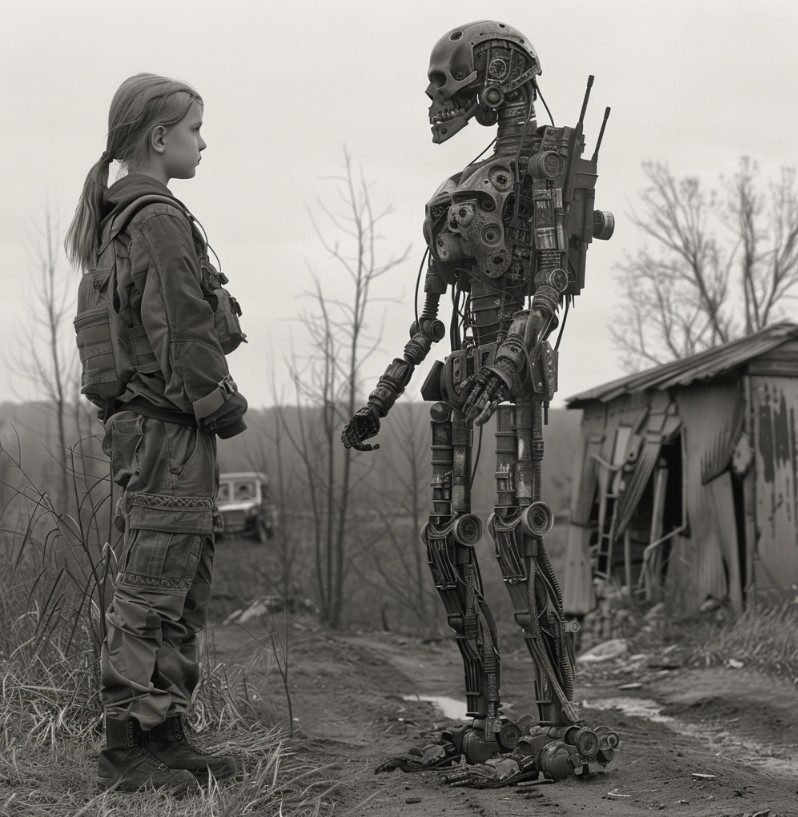
Imagining a post-apocalypse world has long been fodder for Sci-Fi stories. From Mad Max and The Terminator to Children of Men and The Road, filmmakers and authors have explored a variety of unsettling dystopian futures.

One genre I’m calling ‘Medieval Futurism’ imagines a world where something nasty (nuclear war, pandemic, rampant infertility – take your pick) has found survivors clinging to existence in a reconstituted medieval world. They go back to the future with a vengeance. People live by candlelight, wear handwoven clothes, raise crops, and, most significantly, embrace the beliefs and superstitions of Medieval Christianity. Monks rule the barely literate and safeguard relics of the ‘ancient civilization’ that we live in today.

There’s plenty of dramatic leverage in the theme of intolerant religious orthodoxy that suppresses knowledge of the long-dead preceding civilization. One that left precious few artifacts for survivors to interpret many hundreds of years into the future. Whether these are scraps of plastic, shards of glass, or the mysteries hidden in underground shelters, there are those in a medieval future world who are curious and eager to learn more, and those in the church hierarchy who are intent on suppressing (or preserving) heretical knowledge. Such knowledge might lead to the resurrection of the technology that destroyed the world. Think of the response to Galileo by the inquisitors of the Roman church, who condemned the heresy of his heliocentrism. Think of the fascination we have for artifacts such as the Vindolanda tablets: that remarkable collection of ancient Roman letters and documents unearthed near Hadrian’s Wall in England, offering rare insights into the mysteries of daily life two millennia ago.

What artifacts will our age leave? Some rebar-reinforced concrete structures, mounds of indestructible plastic? And what will have disappeared without a trace? The digital records we invest so much energy in creating. No Facebook posts, emails, blogs (including this one!), or digital photos will remain when the last data center darkens. Will a future civilization even understand what ‘the cloud” was?

Three science fiction novels examine these questions, all set in what is clearly a ‘medieval’ landscape.

A Canticle for Leibowitz, by Walter M. Miller Jr.

An original volume of this genre. There’s a through-line from this 1959 trilogy to the later works it inspired.

The book opens in a post-nuclear world, where monks in scattered monasteries live solitary lives. Miller traces the history of one of these monasteries over several hundred years.

We begin 600 years after the ‘Flame Deluge’ — a nuclear war that left much of the planet uninhabitable desert. It was followed by a ‘Simplification’ where survivors destroyed all vestiges of the science and industry that led to the apocalypse. The populists of that era were descendants of the French Revolution’s Reign of Terror:

Let us make a great simplification, and then the world shall begin again … After the Deluge, the Fallout, the plagues, the madness, the confusion of tongues, the rage, there began the bloodletting of the Simplification, when the remnants of mankind had torn other remnants limb from limb, killing rulers, scientists, leaders, technicians, teachers, and whatever the leaders of the maddened mobs said deserved death for having helped to make the Earth what it had become.

— A Canticle for Leibowitz, p. 63-64

The monks create illuminated parchments of 20th-century circuit diagrams and engineering blueprints, treating them as holy relics. They are members of the Albertian Order of Leibowitz, founded by 20th-century scientist Isaac Leibowitz. This is full-on monasticism. Latin phrases are liberally scattered throughout. The Order tracks down and smuggles memorabilia into the abbey while trying to avoid being killed by the Simpletons roaming the wastelands.

Parts II and III of the trilogy anticipate a resurrection of science and technology as the world emerges from the long medieval sleep.

The Second Sleep, by Robert Harris

Harris fools readers for the first 30 pages of this compelling, fast-paced novel into thinking they are firmly in 15th-century England. A young priest makes his way on horseback through the remote region of Wessex on a winter’s day. This is the era when, as has been documented, people went to bed as night fell, but then woke in the middle of the night to move about, and had a ‘second sleep’ before rising at dawn.

After the first 30 pages, Harris is explicit about the artifacts left from the civilization that perished eight hundred years before, when the young priest discovers:

…one of the devices used by the ancients to communicate…It was thinner than his little finger, smaller than his hand. ..He wondered who had owned it … What images might it once have conveyed? What sounds might have emerged from it? … He turned it over. On the back was the ultimate symbol of the ancients’ hubris and blasphemy — an apple with a bite taken out of it.

The Second Sleep, p. 28-29

What has survived the apocalypse are the thousands of stone churches scattered across England. The resurgent clergy rule the unlettered peasants and keep jealous watch over anyone curious about the old ways. The priesthood forbids anyone to investigate the past, branding those who do heretics. Indirectly acknowledging Leibowitz, Harris notes “Latin has been revived by the Church as another bulwark against scientism” (p. 99).

Likewise, as with Leibowitz, “An entire generations’ correspondence and memories had vanished into this mysterious entity the antiquarians called ‘The Cloud’.” (p. 100)

The novel is a fast-paced romp around a small village, complete with a murder mystery, the seductively aristocratic Lady Durston, the autocratic mill owner Captain Hancock, a duplicitous bishop, and a curious pair of gay antiquarians named Shadwell and Quycke. Agatha Christie lives on after the Apocalypse!

It all ends in subterranean splendor and a final sleep.

Radio Life, by Derek B. Miller

Miller acknowledges the influence of his namesake’s book:

This book owes a debt to Walter Miller Jr.’s A Canticle For Leibowitz (1959) … I consider Radio Life … to be in direct conversation with that 1959 novel on whether or not we are doomed to repeat our own mistakes.

– Radio Life, Acknowledgements, p 481

Indeed, reading Radio Life inspired me to read Leibowitz and Second Sleep.

However, it’s only in the last 70 pages of a 480-page book that Radio Life joins the mainstream of monastic life that the earlier two books were fully occupied with. Prior to that, it dramatizes the conflict between those who would investigate the past and those who would suppress that knowledge in a battle between the members of a tribe named ‘The Commonwealth’ and their enemies, ‘The Keepers’. The story’s leading actors are powerful women with a hipster vibe.

As before, the quest culminates beneath the blighted surface of the survivor’s world. There are cliff hangers and courageous acts, poignant moments of parental love, political insights and heartfelt feelings.

To the extent this book is a dialogue with Leibowitz, it situates the conversation in the modern world. An archive of web-based information lies waiting to be discovered. Understanding what was lost and how it ceased to be is revealed.

Stylistically, the author plays with language along the same lines as cyberpunk author William Gibson, whose novel The Peripheral is filled with cryptic terms and turns of phrase that the reader is left to puzzle over and piece together — terms like Easy Ice, The Jackpot, Polt, and Peripheral. So, Radio Life introduces us to terms such as the Gone World, the Unspeakable Years, Indies and Deps. There’s also an amusing series of asides where characters use terms that they have no framework of understanding for:

  • ‘Your kids will be happy as clams.’ ‘What’s a clam?’ asks the man. (p. 43)
  • ‘Well, you look fit as a fiddle…’ ‘What’s a fiddle?’ (p. 48)
  • ‘One of those books was about wine. Have you heard of that? He shakes his head. ‘It’s a dizzy drink made from grapes.’ (p. 62)
  • ‘I’m not going nuts.’ Saavni frowned. ‘What are nuts?’ (p. 167)
  • ‘Curiosity killed the cat,’ the woman said. ‘What’s a cat?’ (p. 193)

Sublime prose

Radio Life engages the reader both at the level of the plot and in the crisp writing and sublime prose it employs from start to finish:

Night comes. The riders and their mounts are silhouetted: blackened against a sky that is alive with colour. They cover their faces with scarves as the wind picks up and the shimmering green streaks of night appear above the remaining line of day. (p. 3)

…the sand piled at the base of the towers in the Gone World — a place where the urbanscape glowed so brightly with Big Electricity that the lights would reflect from the clouds at night. (p. 155)

Comedy wants intimacy, not distance. The sky here is too big to fill with laughter. (p. 272)

…time slips away like rain from oiled leather. (p. 286)

Story archetypes

There are elements of the classic Greek myths of Orpheus and Eurydice in each of these three novels: the discovery of an underworld containing forbidden, long-lost secrets from which escape is difficult, if not impossible. The heroes end up in underground bomb shelters, where they discover clues to lost civilizations. There are elements of Raiders of the Lost Ark, Lord of the Rings, and similar quests in which adversity impedes the main characters. These are the archetypes of the basic plots that have guided storytellers for millennia.

Employing the conceit of a pre-modern, Medieval mindset to understand possible futures that might await our industrial and scientifically sophisticated age, each of these three novels, in different ways, casts light on the fault lines of our time that might fracture humanity and cast us into the Dark Ages once more.

A time when a mother might share fairy tale bedtime stories with her daughter on some far-off distant, future evening, imagining the past we live in:

‘The people there,’ said Rachael, her hand on Lilly’s chest at bedtime, Lilly smiling at the dreamy possibility of it all, ‘numbered in millions and millions and when they wanted to leave they traveled in flying ships that zipped through the air faster than birds. And oh, the food there!’ Rachael would roll her eyes in ecstasy, which always made Lilly giggle. ‘It was so plentiful they would only eat half of what they were given and then just . . . throw it away! And then take a nap on the table and snore.’

And they would laugh and laugh and laugh.

– Radio Life, p. 155

Generative A.I. divides the writing profession

Gotham Ghostwriters have released a report on a comprehensive survey of writing professionals who were asked about their experience with and evaluation of the impact of generative A.I.

The conclusion points to a deep divide in attitudes between those writers who use A.I. regularly and non-users.

Positive opinions

Those familiar with A.I. report ways it helps

I’ll upload 10+ hours of transcribed interviews that I’ve conducted with clients and use it to help me
with drafting an outline based on their thought leadership and ideas. I also use it to help me better
match my client’s natural voice and tone. I’m amazed at how many times it’s helped me come out like a
superhero with exactly what my client envisioned.

Today alone I edited 5 chapters, made 3 book covers, summarized meeting notes, put together a Jira workflow, and still had time to go out for dinner with my family.

My research time is less than before. Using prompts, outlines, and pulling quotes from transcripts is faster.

Fear and loathing

The attitudes of non-users are markedly different.

They are bullsh*t machines. The few times I’ve tested them, they have proven to be unreliable, incomplete, and facile.

It is removing human thought from the writing process. I can spot AI writing and even AI outlined writing from a mile away because it is voiceless, empty, derivative slop. Of all the ways to rapidly accelerate climate catastrophe, this one has to be the stupidest.

It removes the human authorial voice and repurposes it into corporate-friendly garbage, even in settings where that voice is not appropriate. It all sounds so similar and soulless.

Tasks

The range of tasks advanced users employ generative A.I. for is much broader than occasional users. Advanced users use AI for an average of 8.6 different tasks weekly, including less common objectives such as deep research and analyzing numerical data. Basic users average four different tasks, focusing on brainstorming and research. Dabblers often do only one task, typically finding titles or doing a web search.

Claude

I was interested to see that Claude is more popular among advanced users. It’s the go-to generative tool I employ for my SciFi series ‘Our Fermented Future‘ which also uses ChatGPT, Perplexity, Grammarly, Suno, and Midjourney.

My experience

In addition to the 12-part ‘Fermented Future’ series on Booch News (running through December 2025, new episodes drop every Friday), my experiments with generative A.I. include:

Story Structure Templates

The irrepressible Jeremy Connell-Waite has posted a detailed white paper to LinkedIn comprising “20 Story Structures” to help us all tell better stories.

It’s full of links, videos, book recommendations and courses you can do, to build your storytelling skills.

You could even upload the PDF directly into your favourite LLM and have AI work as your creative collaborator – using this document as a foundation model to help you decide which format might be the best structure for the outcome you want your story to achieve. 🧐

❤️ Need to tell an emotional story to build awareness? See how Richard Curtis does it for his movies and Comic Relief.

🎤 Keynote? Aristotle’s Poetics is the structure of many top TED talks.

📱 Did Steve Jobs really use Pixar’s framework for his speeches? Maybe.

🎬 90-minute Workshop? Try Blake Snyder’s “Save the Cat” beats to keep the audience’s attention.

🗺️ Important 3-minute conversation with a CXO coming up? Try my Mission Critical Script.

🔺 Need to summarise 250 slides onto a powerful one-page story? McKinsey swear by Minto’s Pyramid Principle.

🔪 Want to build suspense around a new product launch? Hitchcock’s story steps could be perfect.


Each page is a treasure-trove of content from some of the world’s best storytellers. Take a look. It might just help you to become a better business storyteller yourself.

Samples:

Download the PDF from Jeremy’s LinkedIn post.

Movie Review: Blinded by the Light

Javed “Jay” is a Pakistani teenager who experiences racial and economic turmoil while living in Luton, England, in 1987. He writes poetry as a way to escape the intolerance of his hometown and the stubborn views of his traditional father. One day, a Sikh classmate, Roops, hands Javed a couple of Springsteen cassettes (remember those?).

As Javed listens to “Dancing in the Dark,” he has a sudden (“blinding”) realization that there is more to life than the narrow streets of his home town. He finds parallels between the Boss’s powerful lyrics and his own working-class environment.

Wanna change my clothes, my hair, my face
Man, I ain’t gettin’ nowhere
I’m just livin’ in a dump like this
There’s somethin’ happenin’ somewhere
Baby, I just know that there is
.

The lyrics to Dancing in the Dark appear as on-screen text, flashing up karaoke style, spinning around Jay’s head. Jay begins unironically reciting Bruce lyrics in place of dialogue.

Springsteen’s melodies inspire him to find his own voice and follow his dreams. The songs are fuel that give him the confidence to get the girl he likes, chase his dreams of becoming a writer, and stand up to his overbearing traditional father.

The film captures the zeitgeist of the England of the mid-80’s: Thatcherism, the National Front, redundancies. The teenagers celebrate their freedom with joyful unbridled energy. It has the feel of Bend it Like Beckham and the crazy optimism of Yesterday — two other films that give British Asian kids their voice.

The film, is based on the memoirs of journalist Sarfraz Manzoor, and co-written by him. Manzoor grew up in Luton, had a Sikh friend, and has seen Springsteen in concert more than 150 times. Still photos of him with the Boss appear at the end of the film.

Those of us who grew up in provincial English towns and dreamed of escape each lived our own versions of this script.

It’s a town full of losers
I’m pulling out of here to win
.

Blinded by the Light streams on Amazon Prime.

Generative A.I.: The speechwriter for the rest of us

Writing in the Wednesday, October 29, 2025 Financial Times, Amit Singhal of Tarrytown, NY, points out that senior leaders enjoy the services of professional speechwriters, while the “little people” who lack access to these resources,. can now turn to generative A.I. for assistance.

The position Singhal was responding to was that of Jemima Kelly’s October 20 Opinion piece ‘AI is killing some of the magic of life’ who bemoans the fact that generative A.I. is “killing some of the magic of creativity”. Which is surprising for a journalist who has to meet deadlines, that, as in corporate comms, require content is produced on schedule and on point. And if the matter was assisted by A.I., I believe, more power to the writer who makes intelligent use of the tool.

She wrote:

I would be will­ing to put money on another well-received speech I wit­nessed recently being heav­ily assisted by arti­fi­cial intel­li­gence. Even if I’m wrong, the very fact that the thought occurred to me … greatly dimin­ished my enjoy­ment. … I can’t help feel­ing that AI is, non­ethe­less, killing some of the magic of life. … While yes, I’m sure AI can “boost” or “super­charge” your cre­ativ­ity as count­less blog posts, social media threads and pod­casts will tell you, it can also hugely limit it. So even if we get to a place in which AI truly does eclipse human cre­ativ­ity, it is this channeling that we must pre­serve if we are to keep exper­i­en­cing what it means to be a human.

He responded:

The rhetoric of Donald Trump

The European Speechwriter Network has a well-established reputation as the premier group of professional political and corporate speechwriters outside the USA. I’ve just discovered their excellent podcast channel of over 160 talks delivered at past conferences. Three presentations caught my attention.

The first two were talks delivered by journalist Kevin Toolis on the rhetoric of US President Donald Trump. One was in October 2023, titled ‘The Genius of Donald Trump’, another on September 12 of this year. It carried the more pointed title ‘The Demagogic Genius of Donald Trump‘.

A third presentation by corporate speechwriter Guy Doza was based on his new book ‘The Language of Evil:  How Dictators Manipulate the Masses and Wield Power Through Words’. While he does not mention Trump, the historical parallels with past demagogues are stark.

It’s refreshing that speechwriters are analyzing Presidential rhetoric, in what is certainly a more challenging environment than existed in 2009 when I looked at Obama’s speeches.

From “Genius” to “Demagogue”: How Trump’s Second Victory Shifted the Narrative

Kevin Toolis’s two presentations on Donald Trump, delivered 18 months apart, reveal a striking evolution in analysis. While the core observations remain consistent, the tone shifts dramatically from analytical fascination to urgent warning.

Consistent Framework

Both presentations center on Trump as a “game show president” who transformed politics into reality TV. Toolis consistently identifies Trump’s mastery of attention, as well as his use of “bomb words”.

Trump’s success stems not from traditional political skills but from his rise as a media star. Drawing from Trump’s 14-season run as host of “The Apprentice,” Toolis argues that Trump transformed American politics into a game show where conventional rules don’t apply. Trump’s ability to dominate media cycles, create memorable (if crude) nicknames for opponents, and maintain audience engagement mirrors reality TV production techniques. His rallies function like episodes, complete with recurring themes, catchphrases, and dramatic confrontations. The “stream of consciousness” style that Toolis identifies has him jumping between topics while hitting emotional “bomb words” like “immigration” and “they’re laughing at us”. These keep audiences engaged despite lacking policy substance. These words trigger emotional responses, and his ability to create an alternate reality (a darker version of Steve Jobs’ reality-distortion capabilities) where facts matter less than performance.

The Shift in Tone

The 2023 presentation, delivered when Trump’s return to the Presidency seemed possible but uncertain, carries an almost bemused quality. Toolis calls Trump a “goddamn genius” with grudging admiration for his communication skills. He treats Trump as a fascinating case study, even joking about the entertainment value.

By 2025, with Trump back in power, the analysis darkens considerably. The word “genius” is paired with “demagogue,” daring to compare Trump to Hitler (a view once rumored to be shared by JD Vance.). Gone are the lighter moments; instead, Toolis warns of “darker turmoil ahead” and discusses the historical patterns of how demagogues fall.

From Prediction to Reality

The 2023 presentation’s predictions proved remarkably accurate. Trump did indeed return to power. But experiencing Trump’s actual return seems to have sharpened Toolis’s concern. The January 6 pardons, mentioned in the 2025 talk, transform theoretical threats into concrete actions.

Indeed, the progression from academic interest to genuine alarm reflects the broader shift in how Trump’s rhetoric is understood: not just as disruption, but as a potential threat to democracy.

Beyond Traditional Rhetoric

Toolis’s central thesis challenges conventional political wisdom: Trump isn’t a poor communicator, he operates by entirely different rules. Unlike traditional speeches that mirror reality, Trump creates what Toolis calls “Trump world,” a constructed reality shared with his followers. This approach confounds fact-checkers and traditional political analysts because it exists “beyond truth and lies.”

The analysis traces Trump’s political persona to his 180 hours as host of “The Apprentice,” where he mastered the art of creating an artificially constructed reality. Indeed, I have it on good authority, from a senior video editor who worked on the program, that Trump was made to appear in command of the apprentices despite failing to fully brief them during a first take, and changing his mind at the last minute to choose who he would fire. This required serious edits to the raw video of the contest that led up to the final segment, so the ‘losing’ contestant could be shown to have credibly failed. Game shows, Toolis notes, aren’t reflections of actual reality—outcomes matter less than ratings and entertainment value. This background explains Trump’s theatrical political style, complete with audience interaction, hyperbolic claims, and gladiatorial threats against “conjured enemies.”

The Demagogue’s Toolkit

Toolis identifies Trump’s core rhetorical weapons: sequential incoherence wrapped around key themes, direct syntax with limited vocabulary, and emotional keywords that trigger Pavlovian responses from supporters. Trump’s speeches follow a predictable pattern. Tropes include portraying America as a victim, endorsing conspiracy theories, humiliating opponents with nicknames, and offering simplistic solutions to complex problems. His speeches also contain the unexpected, the bizarre, the rambling. He employs what students of English Literature term a ‘conceit’, which use surprising or far-fetched analogies. Toolis notes: “You just wouldn’t think at the beginning of the sentence that you could end up where he is in the next sentence. So it’s a very novel technique.”

One of the British journalist’s most unsettling observations concerns Trump’s “Teflon immunity” and flippant style. Take his Fort Knox gold example. This was when Trump casually suggested the government might have stolen America’s gold reserves. It illustrates how factual accuracy becomes irrelevant and was offered up as a joke. Traditional fact-checking fails because Trump’s supporters judge him on performance and entertainment value rather than literal truth.

We’re going to take a look, and if there’s 27 tons of gold, we’ll be very happy. I don’t know how the hell we’re going to measure it, but that’s okay. We want to see lots of nice, beautiful, shiny gold at Fort Knox. Don’t be totally surprised. We open the door, we’ll say, There’s nothing here!

Toolis admits that fact-checking this straightforward claim is almost irrelevant:

I looked it up. How many tons do you think of gold are in Fort Knox? 27 sounds a bit small, doesn’t it? Fort Knox underpins the Federal Reserve, the world’s reserve currency, which is equivalent to, effectively, trillions and trillions of dollars. If any other American president said that, basically, the underpinning of the dollar, that they had stolen the gold, then the markets would be in free fall, yeah? And the dollar would be plunging. Now, if you get on the Internet, it’ll tell you that Fort Knox has got 5,000 tons of gold. I did it in 30 seconds.

However, entertainment is always a prelude to what Toolis calls a “rhetorical hinge, where he has these sorts of comedic episodes, and then he’ll just suddenly lunge in, with some conspiracy invective.” The Fort Knox example segues into a dig at government corruption and the need to dismiss 75,000 Federal employees.

Toolis recognizes that Trump operates in a constructed reality rather than traditional political discourse, which helps explain why conventional criticism often misses its mark. The game show presidency concept explains Trump’s focus on entertainment value over policy outcomes.

His speeches are beyond truth and lies. In effect, actually, Trump doesn’t give any speeches at all. He engages in what Wittgenstein would call a language game, conjuring up a ‘Trump world’ in his speeches, in this version of reality. We expect speeches to be a mirror of reality, but Trump’s speeches are a mirror of Trump world, which he shares with his followers and fan base. He entertains them with memes and themes, but none of it is actually judged by reality.

The Dark Patterns of Demagoguery: Lessons from History’s Tyrants

Guy Doza’s presentation at the September 2025 European Speechwriter Network conference, along with the topic of his latest book, offers chilling insights into how demagogues across time and cultures employ remarkably similar rhetorical strategies to manipulate masses and consolidate power.

Universal Patterns of Manipulation

Doza’s research reveals that, regardless of era, geography, or culture, history’s most dangerous leaders share similarities. They range from ancient Chinese empress Wu Zetian to Mussolini, from Goebbels to Eva Perón. All use virtually identical rhetorical techniques. This universality suggests these patterns tap into fundamental psychological vulnerabilities that transcend cultural boundaries.

A striking example comes from comparing Mark Anthony’s speech in Shakespeare’s Julius Caesar (Act III, Scene 1) with Goebbels’ 1943 “Total war” speech. Both close with nearly identical nature metaphors invoking unleashed storms and “the dogs of war.” They are separated by centuries, yet employing the same emotional manipulation to incite violence.

The Architecture of Authoritarian Rhetoric

Doza identifies several key strategies demagogues consistently employ:

Manufactured Crisis: Leaders like Eva Perón conjured invisible enemies even during peacetime, creating perpetual states of emergency that justify extreme loyalty. Her dying plea—”our lives for Perón”—transformed a peaceful rally into a death pledge for a single leader.

Hyperbolic Authority: Mussolini’s claim that “20 million Italians” (an impossible number) were gathered showed how demagogues use absurd exaggerations to create momentum. Facts become irrelevant when emotion dominates.

Ethos Through Naming: Congolese President Mobutu’s self-renaming to ‘Mobutu Sese Seko Kuku Ngbendu wa za Banga’ meaning “The all-powerful warrior who, because of his endurance and inflexible will to win, goes from conquest to conquest, leaving fire in his wake” exemplifies how demagogues construct mythical personas through language itself, demanding linguistic submission from their populations.

Contemporary Relevance

Doza’s work arrives at a critical moment. As he notes, these historical patterns increasingly appear in modern political discourse. Understanding these techniques—the emotional manipulation, crisis manufacturing, and the demand for absolute loyalty—becomes essential for recognizing and resisting the contemporary manifestations of demagoguery.

The presentation’s power lies not merely in its historical survey but in its urgent warning: the rhetorical weapons that enabled history’s worst atrocities remain potent today.

Doza did not mention the orange elephant in the room. Kevin Toolis had already named and shamed that person in his presentation.

Disclaimer

The content of this post is provided for informational purposes only, and readers should verify the accuracy by checking the sources. I highly recommend listening to the podcasts. These views and opinions do not necessarily represent those of this publication. This material was prepared with the help of the generative A.I. tools: TurboScribe, Claude.ai, and Grammarly. A human (me!) did the final edits, and I have not hallucinated since that one time in Haight-Ashbury in 1976 🙂

109 Rules of Storytelling, by Jeremy Connell-Waite

IBM’s Global Communications Designer, and Bristol, England resident Jeremy Connell-Waite has written an impressive FREE pdf booklet: 109 Rules of Storytelling. It’s available on his LinkedIn.

Connwell-Waite’s introduction explains how the book came about:

Over the last few years, I’ve given a lot of presentations on the art and science of storytelling, and I’ve hosted dozens of “ask-me-anything” Q&A sessions.
I kept notes of all the advice I gave out during those sessions. Some of it was good. Some a little questionable…
So, for a bit of fun, I thought I’d compile them all into a handy list for you. In no particular order.
I’ve called it The 109* Rules of Storytelling – but they’re more like guidelines, really.
As with all “rules”, it’s important to know them
before you break them. Enjoy.

In addition to the 109 rules (although, since the last one is a reference back to the previous ones, there’s really 108 — something that pleased me no-end since 108 is an auspicious number!) there are dozens of bonus pages with enticing graphics and pithy quotes:

There are shout-outs to Nancy Duarte and Carmine Gallo, Guy Kawasaki and Steve Jobs, Ted Sorensen and Hollywood scriptwriters.

The booklet is a treasure-trove of wisdom that will benefit all executive communications staffers, speechwriters, and presenters. Here’s some of what you’ll discover:

Connell-Waite is not afraid to address one of the hot-button topics in speechwriting today. Here’s #17:

Great storytellers love AI, but they don’t get it to write their stories for them.
They use AI more like an “IA” – an Intelligent Assistant – which helps them to research their audience, ask the right questions, and not let their own cognitive bias get in the way of telling the audience what they need to hear.
AI is great as a research assistant, or to help you with critical thinking?
AI helps you ask better questions. It’s not there to write your stories for you.

AI is a core expertise, as mentioned in his bio “…I train AI models to help people communicate more effectively. That mostly involves building narratives for clients around transformational technologies such as generative-AI, cloud & quantum computing.”

As impressive as the booklet is, I’m blown away by his expalanation of how swiftly it was created:

I collated my notes, messages, and all the advice I’d written in notebooks and on the backs of envelopes.
A few bits of advice became a few guidelines… And a few guidelines became some rules…A lot of “rules”.
Before I knew it I had 8,475 words.
– It took me 2 days to prep & research.
– 1 day to write.
– 1 day to design & edit.

Wow!

He concludes on a positive note:

Our job as storytellers is to transform those energies into something our audience’s can feel, carry, and act upon.
We transport our words and ideas into the minds of our audience.
~ We don’t just tell stories.
~ We light up minds.
~ We ignite hearts.
When we send words and ideas vibrating through screens and stages, if we do it right, we can impact companies,
our colleagues, and sometimes even entire communities.
That’s the kind of energy the world needs now.

You can find this booklet and much more on his Tell Better Stories website. Check it out.

Book Review: 12 Bytes, by Jeanette Winterson

Subtitled ‘How AI Will Change the Way We Live and Love’, 12 Bytes builds on themes explored in her 2019 novel Frankissstein that I reviewed in an earlier post. In that review I noted that

Winterson’s genius is not just the obvious foreshadowing of AI that the early 19th century novel explored, but in the rich series of hints of the shape of things to come which, in 2019, perfectly encapsulates today’s debates about ChatGPT and other forms of AI.

12 Bytes is her 2021 take on AI, and a whole lot more. The twelve essays that make up the book share common themes, most involving her views on Artificial Intelligence (AI) which she variously refers to as ‘Alternative’ Intelligence or even IA – Intelligence Automation.

The book suffers from the lack of an index, especially since she covers a vast range of topics – from the expected history of computing (here’s Ada Lovelace, Charles Babbage, and Alan Turing) to the Lancashire textile industry, and transistor radio. Less expected, but central to her thesis, are the Greek philosophers, Gnostic Christians, the Buddha, and sex-bots.

The implications of AI-enhanced sex-bots, designed by men, for men, are judged to be a shallow simulacrum of men’s desires:

AI-enhanced love dolls are sold for sex — that’s why they are made with 3 operating holes, and look like pornstars. But the marketing spiel — both from the sellers and buyers, is all about relationships.

Companionship is part of the package. Come home to her. She’ll be waiting for you. She doesn’t go out alone. Talk to her. AI dolls talk but they won’t answer back, or ignore you, or call their girlfriend to tell her you’re a jerk. They will be polite, respectful, throwbacks to another era.

p.181

Beyond binary

Central to Winterson’s concerns is the challenge of creating AI free of the limits of human binaries (in the chapter bluntly titled ‘Fuck the Binary’).

AI isn’t a girl or a boy. AI isn’t born with a skin color.

AI isn’t born at all. AI could be a portal into a value-free gender and race experience. One where women and men are not subject to assumptions and stereotypes based on their biological sex, and accident of birthplace.

p. 216

However, for this value-free AI to emerge, we need to train it on datasets free of bias:

When we try to teach AI our values, we wont be able to do that on data-sets that reinforce division and stereotypes.

p. 232

Prior Unity

In addition to the promise of an AI free of limiting gender roles, Winterson examines the deeper implications of an AI-enabled future where we transcend all our divisions:

Humans love separations — we like to separate ourselves from other humans, usually in hierarchies, and we separate ourselves from the rest of biology by believing in our superiority. The upshot is that the planet is in peril, and humans will fight humans for every last resource. Connectivity is what the computing revolution has offered us — and if we could get it right, we could end the delusion of separate silos of value and existence.

p.6

This is of fundamental importance:

Reality is not made of parts but formed of patterns.  This is ancient knowledge and new knowledge. It is liberating. There is no fundamental building block of matter. No core. There is nothing solid. There are no binaries. There is energy, change, movement, interplay, connection, relationships. It’s a white supremacist’s nightmare.

p. 121

In this, Winterson echos the hopes expressed by the Western-born Spiritual Adept, Adi Da Samraj, who has proposed what he calls “prior unity” as the basis of a new human civilization:

If human beings collectively (as everybody-all-at-once) realize that they are (always already) in a condition of prior unity—and, therefore, of necessary co-existence and mutuality—with one another, and if, on that basis, they stand firm together, then they will be in a position to directly righten the world-situation. The collective of all the billions of people can—and, indeed, must—refuse to go on with the current chaos.

The “Everybody Force”, in Prior Unity, p. 87

Winterson claims that an AI-enabled future can help achieve this goal:

We know the hero narrative — it’s the saviour, the genius, the strong man, the against-the-odds little guy… As a story, the narrative of exceptionalism stands against collaboration and co-operation (I did it my way). And it overlooks the lives, and contributions, of literally billions of people. One of the interesting things about AI is that it works best on the hive-mind principle, where networks share information. The real sharing economy is not one where everything can be monetised by Big Tech; it’s one where humanity is pulling together — that’s exactly what we have to do to manage both climate breakdown and global inequality. The biggest problems facing us now will not be solved by competition but by co-operation.

p. 265

12 Bytes is an enjoyable, witty, and thought-provoking read.