Guest Posting: How to Write and Deliver a Great Speech, by Simon Lancaster

Simon LancasterSimon Lancaster is one of the world’s top speechwriters. He first became a speechwriter in the late 1990s, working for members of Tony Blair’s Cabinet. Today, he writes speeches for the CEOs of some of the biggest companies in the world, including Unilever, HSBC and Intercontinental Hotels. Simon is a visiting lecturer at Cambridge University and an Executive Fellow of Henley Business School. He regularly appears on BBC and Sky News and writes guest columns for The Guardian, The Daily Mail and Total Politics. He is the author of two best-selling books on communication: Speechwriting: The Expert Guide and Winning Minds: Secrets from the Language of Leadership. You can follow him on Twitter @bespokespeeches

How to Write and Deliver a Great Speech

Emmeline Pankhurst’s speeches led to women winning the vote. Winston Churchill’s speeches inspired a nation to stay strong at a time of war. Dr Martin Luther King’s speeches persuaded the American Government to grant everyone equal rights, regardless of the colour of their skin.

Speeches change the world. Throughout history, whoever has held the gift of eloquence has held power: from the Roman Emperors to the kings and queens to politicians.

In the past, we all used to learn public speaking at school. In Ancient Rome and Ancient Greece, rhetoric was a core part of the curriculum. In London, right up until the 19th Century, it was possible to gain a free education in rhetoric but not in maths, such was the importance that was placed on the topic. The thinking was clear: you could not have a fair society unless everyone had a fair opportunity to express themselves.

Today, teaching of rhetoric is restricted to a narrow elite. It is no coincidence that 19 of Britain’s last 50 Prime Ministers went to Eton. Eton has always invested in the teaching of rhetoric. Indeed they have just invested 18 million pounds in a new debating chamber.

Developing tomorrow’s leaders starts in today’s schools. The good news is that all the techniques in great public speaking from Ancient Rome and Ancient Greece remain just as relevant today. Aristotle taught us there are three essential ingredients to a good speech.

Aristotle said a good speech must have:

Character (ethos)
Emotion (pathos)
Argument (logos)

First, the speaker must demonstrate good character (ethos). A speech represents a chance to look into someone’s eyes and see the strength of their conviction. This means that when the person delivering the speech stay true to yourself. It doesn’t matter if they speak too quickly, wave their hands around a lot or um and ah. Great speakers can, and do, get away with all of this. The most important thing is that they believe what they are saying. That is something that just can’t be faked. A speaker must speak from the heart.

The second thing a great speaker does is speak about an issue everyone cares about (pathos). Too many speeches are boring. A speech should be as exciting as a film or a great television programme if it is to hold people’s attention. A great speaker will stir feelings within their audience that even their audience can not wholly explain: feelings of pride, passion or pain. They will tell stories, use emotive points of reference and explain why it is that something matters so much.

The third thing a great speaker must do is sound right (logos). The Ancient Romans used to talk about the rule of three. If you put your argument in threes, people are more likely to believe that it is true. There is something in the human brain that loves arguments that come in threes. ‘This, that and the other.’ ‘On your marks, get set, go!’ ‘Ready, aim, fire!’ Great speakers always use the rule of three – over and over and over again. They also combine it alliteration, rhymes and contrasts. It makes them sound more credible, compelling and convincing.

The world is in a state of flux at the moment. It is scandalous that at a time when such gargantuan issues are being debated – like climate change, security, religious freedoms – debate is being restricted to such a narrow minority.

Instead of teaching our children to sit down and shut up, we should be teaching them to stand up and speak out. Let’s put oracy right at the heart of the curriculum, for today’s children, for tomorrow’s world.

What shall we call this grand initiative? Well, here’s an idea. How about democracy?

Some great speeches to watch and discuss in the classroom:

TEDx talk – Speak like a leader by Simon Lancaster

This post originally appeared in First News Schools UK and is reproduced here with Simon Lancaster’s express permission.

Guest Posting: Rhetoric Revisited: FDR’s “Infamy” Speech, by Robert Lehrman

Former Chief Speechwriter to Vice President Al Gore in the White House, Bob Lehrman has written four novels, the highly praised The Political Speechwriter’s Companion (CQ Press 2009), and has now co-authored and co-edited a new book: Democratic Oratory from JFK to Barack Obama (Palgrave Macmillan 2016). He teaches public speaking and political speechwriting at American University.

Rhetoric Revisited: FDR’s “Infamy” Speech

Really, he’d hoped to spend that afternoon up in the second floor study, magnifying glass in hand, working on the stamp collection that since boyhood had taught him about the world. But FDR was president, with work to do. He was talking policy with one of his aides when Navy Secretary Frank Knox called.

“Mr. President,” he said, sounding doubtful, “it looks like the Japanese have attacked Pearl Harbor.”

Perl Harbor
USS Shaw exploding during the Japanese raid on Pearl Harbor. By an unknown photographer, December 7, 1941. Courtesy of the National Archives and Records Administration.

Roosevelt had no doubts. He knew it was true—and what it meant: war. And a war many Americans did not want, including Charles Lindbergh, whose America First campaign had blocked FDR’s attempt to build up America’s military. Three hours later, FDR called Grace Tully, his secretary, and dictated a speech he would deliver to Congress. The next day, he sat in the House Chamber, wheelchair carefully hidden from photographers, and uttered the words Americans remember about a day “that will live in infamy.”

It’s one of the most famous speeches in American history, though it’s safe to say most Americans remember only that phrase. But on 75th anniversary of the attack, it’s worth asking: What makes it so famous?

It’s not just because the United States would declare war. Who remembers a word of other speeches by presidents asking for war—in 1812, 1846, 1898, or 1917? In fact, I wrote a speech for my boss, Democratic Majority Whip, Bill Gray, during that 1991 debate on the First Gulf War. I remember sitting in the House Chamber watching an incredible sight: Members speaking, then actually sticking around to hear others. I don’t remember the declaration at all.

Is FDR’s speech memorable for its eloquence? No. The language is mostly flat. The readability statistics our computers now provide tell us it’s full of passive voice, with long sentences copyeditors today would think wordy—”In the intervening time,” not “meanwhile.” Even the word “infamy” is a little off; originally he had dictated another word: history. Roosevelt clearly didn’t want to sound neutral, but his usage of ”infamy” was at odds with conventions of the day; a descriptive word, ”infamy” usually appeared the way people talking about FDR often misquote him: “day of infamy.”

Neither was it substantive. FDR rejected the suggestions of those who wanted a longer speech giving listeners context. He wanted to convey urgency to Americans opposed to war.

Did it offer concrete detail—visceral specifics of the attack and casualties? That’s a rule of good speechwriting. Barack Obama used it effectively in 2013, when he told Americans about the Syrian use of chemical warfare: “The images are sickening … a father clutching his dead children, urging them to get up and walk.” Here, FDR gave listeners bland abstractions— “I regret to tell you that very many American lives have been lost.”

But if “Infamy” isn’t notable for its eloquence, it’s still a fascinating speech. Its intrigue lies not only in what FDR told Americans then, but what he didn’t tell them—and what the speech tells us now.

Speech Notes
The first typed draft of FDR’s speech spoke of a “date which will live in world history.” Roosevelt later changed it to the more famous “date which will live in infamy.” Courtesy of the National Archives and Records Administration.

Looking back, for example, the speech gives us a glimpse into how technology could and would influence a nation.

When Woodrow Wilson asked Congress to declare war in 1917, only those in the House Chamber heard and saw him. It took weeks even for the stereopticon slides of his appearance to reach American families. But by 1941 almost 90 percent of American homes had radio. That day four of five families with those radios tuned in to FDR’s noontime speech. The vast acceleration of technology had—literally—electrified a country, and given presidents a way to electrify its people.

Roosevelt’s brevity also exposes the rhetorical devices leaders often use in times of crisis. Take the five-step structure so popular with speechwriters it now has a name: Monroe’s Motivated Sequence (Google it!). In ”Infamy,” Roosevelt uses all five.

First, win attention. Right away, FDR tells us the bad news. ”Yesterday, December 7, 1941—a date which will live in infamy—the United States of America was suddenly and deliberately attacked by naval and air forces of the Empire of Japan.”

Second, present a problem. FDR shows us why the news is bad—not just loss of life, but the threat to Democracy and the evil of the other side. ”The facts of yesterday speak for themselves. The people of the United States have already formed their opinions and well understand the implications to the very life and safety of our nation.”

Third, offer a solution. FDR assures us the country will fight back. ”As Commander-in-Chief of the Army and Navy, I have directed that all measures be taken for our defense.”

Fourth, envision the future: He not only predicts victory but shows absolute certainty about it. ”With confidence in our armed forces—with the unbounded determination of our people—we will gain the inevitable triumph—so help us God.”

Fifth, utter a call to action: FDR calls for one specific act: that Congress declare war. ”I ask that the Congress declare that since the unprovoked and dastardly attack by Japan on Sunday, December seventh, a state of war has existed between the United States and the Japanese Empire.”

FDR Signs
FDR signs the Declaration of War against Japan on December 8, 1941. Courtesy of the National Archives and Records Administration.

They are the steps of many such declarations—and many moments of crisis. In fact, when the space shuttle Challenger exploded in 1986, speechwriter Peggy Noonan’s artful speech let Ronald Reagan make the same points, not about fighting a war but exploring space.

But perhaps the most interesting thing about this speech is what goes unsaid. Let’s be honest—while Roosevelt prided himself on using direct language, as if wanting us to know his views, he was hiding some. He presents a picture of himself taken by surprise—”looking towards the maintenance of peace.” There is no evidence for the allegations that FDR maneuvered the Japanese into attacking Pearl Harbor. But he did know war lay ahead. According to the diary of then-Secretary of War Henry Stimson, two weeks before the attack, he asked aides how to provoke Japan into “firing the first shot without allowing too much danger to ourselves.” The only surprise was where the first shot would be.

And his certainty of the “inevitable triumph”? FDR had many doubts. He didn’t know whether the United States could handle a war fought on two fronts, and told Eleanor he expected many losses.

But when a president declares war, one should expect to hear confidence, not candor.

The decisions about this speech were largely Roosevelt’s own. That was unusual for this president — the first to use speechwriters for most of what he said. Except for a few phrases added by aides, and one echo of Lincoln’s Second Inaugural, the language and strategy for this speech mostly came straight from his mouth into Grace Tully’s manual typewriter.

Would it work? FDR could not be sure.

But three hours after his speech, Congress passed its declaration with only one dissenting vote. It gave FDR the money he needed to rearm. The isolationists gave up the fight. “We have been attacked. We must fight,” Lindbergh said. In the weeks ahead, young Americans filled recruiting stations to enlist.

FDR’s doubts were reasonable. There were many defeats in those opening months. But Americans planted victory gardens, sent sons to fight, and kept in office a president who before the war had been very unpopular.

Dying less than three years later, FDR didn’t live to see the results of those decisions. But the 520 words he dictated then thundered out, set in motion a united and long-lasting response to the threat of Japan and Germany much more dangerous and uncertain than he could let on. FDR didn’t get to spend that afternoon organizing the stamps he loved. But by focusing on the future—he put his stamp on it.

This post originally appeared on the PBS American Experience website and is reprinted here with Mr. Lehrman’s express permission.

She said / He said …

As the dust settles on the recent US election it’s fascinating to read the draft acceptance speeches that were penned by Democratic pundit Bob Lehrman and Republican Aram Bakshian. Bob was Al Gore’s speechwriter and Aram used to write for President Reagan.

Note that these speeches were written 36 hours before the results were known and are ‘what if’ exercises by two professional writers asked to imagine what kind of victory speech Clinton and Trump should give.

Of course, we now know which candidate actually delivered a victory speech in the early hours of November 9th. But both of these drafts are great examples two masters of the art of craft of speechwriting worthy of study.

The Hillary Clinton Victory Speech

Hillary Clinton by Andy FriedmanBob writes a speech that Hillary would have delivered if things had turned out differently. She opens with a subtle nod to the glass ceiling the first woman to become President would have broken. She covers the thanks she would have expressed to her husband; to Obama who had broken the racial barrier that previously kept black men out of the Oval Office (save the slave laborers who helped build it); to her supporters. She does not pull punches in criticizing Donald Trump for debasing the tone of political debate (in a country we now know was base enough to value each midnight tweet, every ‘ugly insult’). She reaches across the divide to embrace the ‘deplorables’ she’d previously dismissed (who we now know did not forgive that blunder, no more than they previously forgave Romney).

Bob employs many of the techniques he explains in his excellent book The Political Speechwriters Companion.

It’s instructive to compare with the victory speech President Obama gave back in 2008.

However, as we all know, this speech, or the version of it that Hillary’s own speechwriters had drafted, was not delivered. Both, together with the candidate, have been consigned to the dustbin of history.

Instead we heard…

The Donald Trump Victory Speech

Donald Trump by Andy FriedmanAram writes a speech that deserves to be read in parallel with the one President-elect Trump actually delivered. What’s immediately apparent is that there are certain required elements in these speeches that any candidate, even one as contrarian as President-elect Trump, must touch on. Thus, thanking your opponent and your supporters; calling for unity; avoiding going off-script … OK scratch that. It’s obvious that Aram’s draft is entirely too coherent for the unique style of this winning candidate. Contrast the measured repetition of
The best trade negotiators…
The best resources for law enforcement…
…the best judges…

with the randomness of

And Lara, unbelievable job, unbelievable.
Rudy Giuliana. Unbelievable, unbelievable. He traveled with us…
Governor Chris Christie, folks, was unbelievable.

Speechwriters are often judged on how well they capture the ‘voice’ of the speaker. I’d venture to suggest that no speechwriter can truly capture The Donald’s voice. However, Aram fails to even include the word ‘beautiful’ which his candidate used frequently during the campaign and again on election night:

Tremendous potential. I’ve gotten to know our country so well — tremendous potential. It’s going to be a beautiful thing.
We’re going to dream of things for our country and beautiful things and successful things once again.
…if Secretariat came in second, Secretariat would not have that big, beautiful bronze bust at the track at Belmont.

He also severely underestimates the use of the all-purpose adjective ‘great’ which he used only three times in the whole speech, whereas it appears that many times in a couple of short sentences:

We’ll have great relationships. We expect to have great, great relationships. No dream is too big, no challenge is too great.

That said he does include the campaign slogan ‘make America great’ which the actual speech omitted.

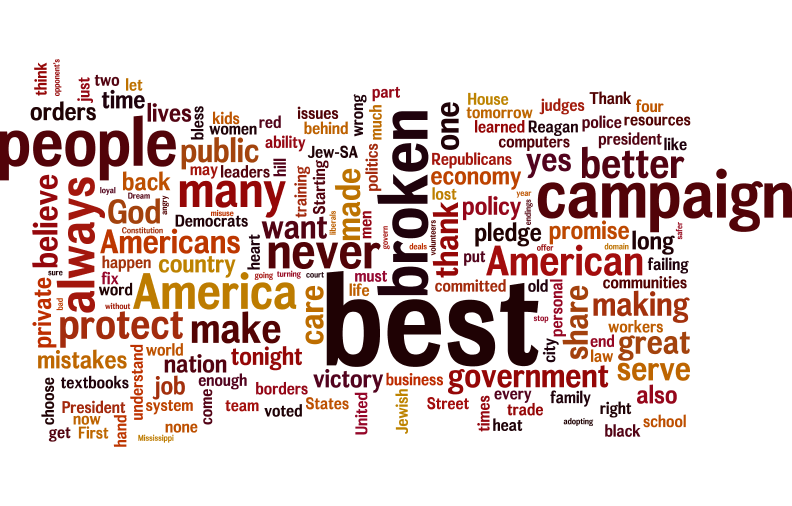
The differences in the speech prepared by the Bush-era professional and that delivered by the President-elect are highlighted by comparing the visual representations below:

As scripted

Aram Bakshian Draft Wordle

Click to enlarge – Image by Wordle.

As delivered

Trump Victory Speech Wordle

Click to enlarge – Image by Wordle.

Indeed, applying Lehrman’s recommendation, Word returns an 8th grade Flesch-Kincaid Grade Level score (a 13-year-old level of understanding) for Aram’s draft, while Trump delivered a speech at was scored at a 4th grade, or typical 9-year-old’s, level of understanding. ‘Nuff said!

I find it fascinating that as a candidate Donald Trump broke so many of the rules of politics, including the speechwriting nostrums in Bob Lehrman’s book, and in so doing destroyed the hopes and ambitions of political professionals of both parties. Perhaps this bears out the truth H.L. Mencken’s trenchant observation.

Hey, it’s all part of the rich tapestry of life in the good ole’ US of A.

The Next Hot Job in Silicon Valley Is Speechwriting

OZY Cover

An interesting post in OZY explains why the next hot job in Silicon Valley is speechwriting.

Leslie Nguyen-Okwu does a great job interviewing David Murray, head of the Professional Speechwriters Association, who comments that

When twentysomethings get “spit out of the administration after working 23 hours a day and [making] shit money,” they’re “interested in working for people who are looking forward and involved in the future.”

She also quotes the views of Google’s Matt Teper.

The claim is that “freelance speechwriters in Silicon Valley get paid more handsomely at $200,000, and in-house speechwriters like O’Conner and Teper can make even higher” which is good news for those at the top of their game with a White House pedigrees. Others might find the rewards are less handsome.

A conversation with Bob Lehrman

On Thursday September 1, members of the Silicon Valley Speechwriters Roundtable hosted a conference call with with renowned author, speechwriter and professor Bob Lehrman.

Bob LehrmanRobert A. Lehrman served as Chief Speechwriter to Vice President Al Gore and, in 2004, as Chief Speechwriter for the Democratic National Committee during his more than three decades of experience writing speeches. His 2009 book, ‘The Political Speechwriters Companion‘ is one of the best books I’ve ever read on speechwriting, period. He’s an editor of the new book ‘Democratic Orators from JFK to Barack Obama‘ (Palgrave/Macmillan 2016) and authored the chapters on the oratory of J.F.K. and Barack Obama.
Bob has written for political figures, celebrities, heads of nonprofits, and corporate CEOs. He created and co-teaches the political speechwriting course at American University, speaks often at other campuses, conferences, and associations, on the topic of political speechwriting, and has conducted four workshops in Hanoi for Vietnamese diplomats. Author of a number of award-winning novels, and many articles for publications like The New York Times, Washington Post, Christian Science Monitor, and Politico, Bob has a B.A. from Tufts University and an M.F.A. from the University of Iowa Writers’ Workshop, where he studied with Kurt Vonnegut and Richard Yates.

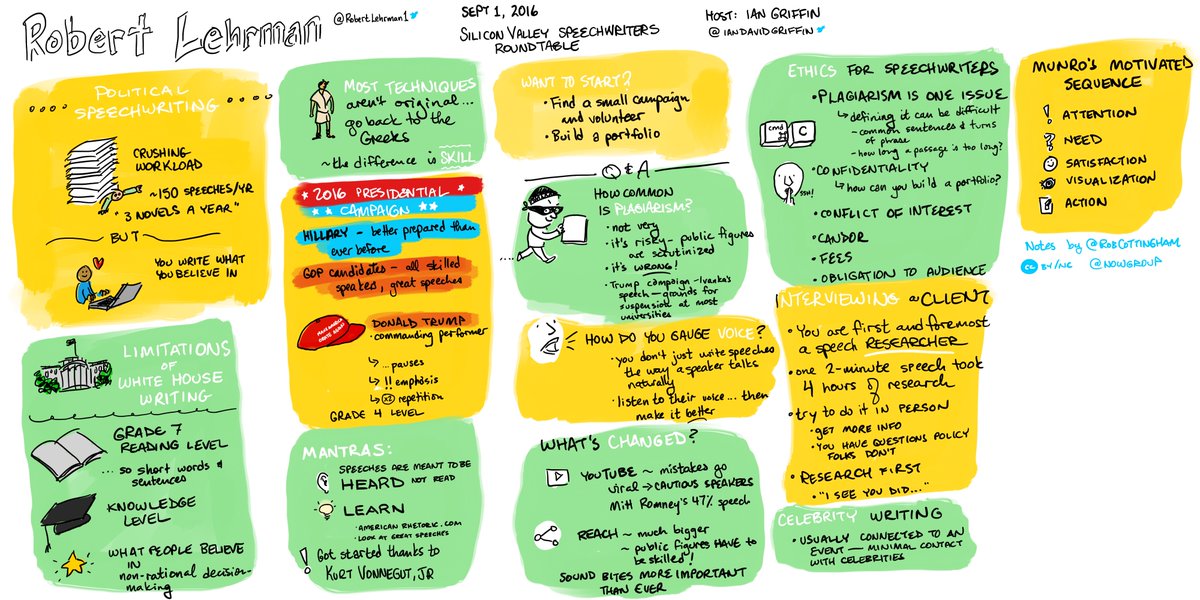
I was going to summarize the topics we discussed on the call, but Rob Cottingham did a great job capturing this in an awesome Sketchnote:

SketchNote

(Click to enlarge)

To listen to the first half hour of the call, click on the podcast icon below.

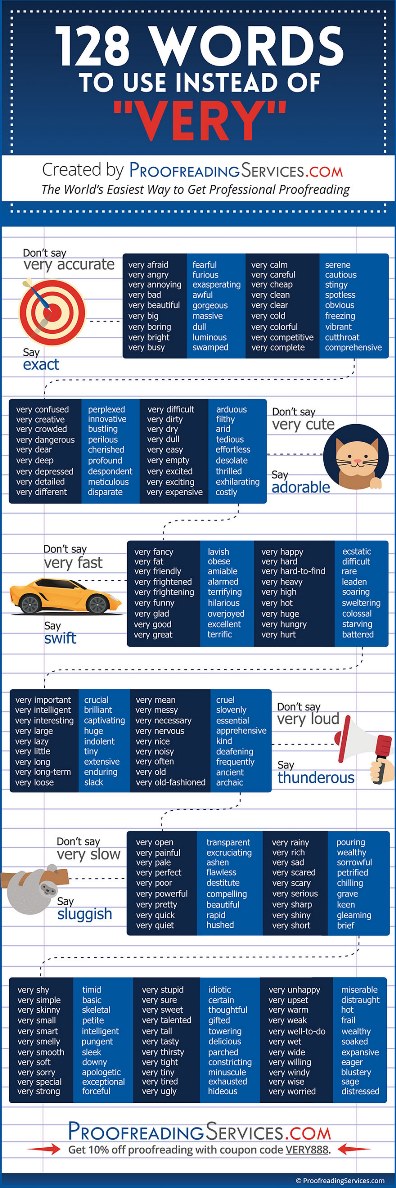
128 Words to Use Instead of ‘Very’

Thanks to Luke at Proofreading Services for creating this very interesting (OK, OK, captivating) infographic:

128 Words to Use instead of Very

Click here for full-sized view.

Announcing: A Conversation with Bob Lehrman

Bob LehrmanAs the U.S. Election Season heads into the final stretch, the Silicon Valley Speechwriters Roundtable is pleased to announce a timely conversation with renowned author, speechwriter and pundit, Bob Lehrman.

We’ll be hosting Bob on a worldwide conference call at 11:45am (Pacific) on Thursday September 1, 2016.

Robert A. Lehrman served as Chief Speechwriter to Vice President Al Gore and, in 2004, as Chief Speechwriter for the Democratic National Committee during his more than three decades of experience writing speeches. His 2009 book, The Political Speechwriters Companion is one of the best books I’ve ever read on speechwriting, period. He’s an editor of the new book Democratic Orators from JFK to Barack Obama (Palgrave/Macmillan 2016) and authored its chapters on the oratory of J.F.K. and Barack Obama.

Bob has written for political figures, celebrities, heads of nonprofits, and corporate CEOs. He created and co-teaches the political speechwriting course at American University, speaks often at other campuses, conferences, and associations, on the topic of political speechwriting, and has conducted four workshops in Hanoi for Vietnamese diplomats. Author of a number of award-winning novels, and many articles for publications like The New York Times, Washington Post, Christian Science Monitor, and Politico, Bob has a B.A. from Tufts University and an M.F.A. from the University of Iowa Writers’ Workshop, where he studied with Kurt Vonnegut and Richard Yates.

The call is open to anyone interested. There’s no charge to attend. Here’s where you can find dial-in & RSVP information.

A Conversation with Sanjay Nambiar

Sanjay NambiarOn Thursday May 5, members of the Silicon Valley Speechwriters Roundtable hosted a conference call with freelance speechwriter, author and publisher Sanjay Nambiar.

Sanjay is a veteran speechwriter and award-winning children’s book author. He has written speeches for CEOs and executives in a wide range of industries, from finance and technology to education and non-profits. Past clients include executives at Toyota, Comcast, and CBS among others.

He also has written several award-winning children’s books. In addition to being a speechwriter and author, Sanjay also is the CEO of SDPH Media, the company behind the multimedia global brand platform for the Super Duper Princess Heroes.

The focus of our conversation was Sanjay’s recommendations for building a freelance speechwriting business as well as his role as an author and publisher (something he has in common with other speechwriters such as Mike Long — playwright — and Justina Chen — young adult fiction author).

Sanjay reviewed the ways he built his client list that started with Search Engine Marketing (SEM) and pay-per-click ads. He also talked about the advantages and disadvantages of options such as Upwork (formally eLance), cold calling and mailing. He shared effective networking and referral techniques. We also discussed his publishing business.

To find out more, click on the podcast icon below to hear edited highlights from the call where Sanjay shares tips on building a freelance speechwriting business.

A Conversation with Matt Teper

Matt TeperOn Wednesday February 24, members of the Silicon Valley Speechwriters Roundtable hosted a conference call with Google speechwriter Matt Teper.

Matt is the Head of Editorial at Google, where he is the leader and founder of the Google Ink team. The team is responsible for defining the voice of Google in major speeches, executive presentations, op-ed’s, blog posts, social media, press statements, internal news, and all manner of creative and editorial work.

Matt is also Eric Schmidt’s speechwriter.

Matt came to Google in 2012, from the White House, where he served as Vice President Joe Biden’s chief speechwriter for the first three-plus years of the Obama administration.

During the call, Matt described what it was like to work for the Vice President, the contrast between the life of a speechwriter in DC and in Silicon Valley and shared his insights about the craft of speechwriting. He also confirms that Google is not, currently, working on a time machine!

To hear a recording of the call click on the link below. Since the call lasts over an hour you might prefer to choose the Download option and listen later.

Book Review: Illuminate, by Nancy Duarte and Patti Sanchez

Casting Light on the Dark Arts of Communications

Any book on communications that starts out quoting 19th century French sociologist Émile Durkheim has my attention. The authors embrace his idea of ‘collective effervescence’ to describe the magic of a group sharing a common purpose.

Illuminate_CoverFor Duarte and Sanchez, the common purpose they champion in the recently published Illuminate is driven by leaders, whom they term ‘Torchbearers’, envisioning new possibilities. They ‘light the path’ as they set out to change the world and bring ’Travelers’ on the journey along with them. If this sounds like the plot to Lord of the Rings, well, in addition to Durkheim, they quote Frodo Baggins, Aragorn and the others as they motivate the hobbits to set out on the quest for the Ring.

However, this book is anything but a fairy tale.

Duarte, Inc is one of the premier communications agencies in Silicon Valley. Since it was founded in 1990, Nancy Duarte has built a stellar reputation as a PowerPoint guru (with her first book, slide:ology) and general communications consultant (cemented by Resonate, her second book). With ‘Illuminate’ she has broadened her scope to include not only presentations and speeches, but stories, ceremonies and symbols. These are all weapons in the ‘torchbearer’s toolkit’ that can be employed to affect what people think, feel and do as they move through what she calls the ‘five stages of a venture’: Dream, Leap, Fight, Climb, and Arrive. If this sounds like the content of a classic 4×5 matrix, well, you’ll find it summarized in a handy-dandy fold-out between pages 58 and 59.

A speech for all seasons

Using this taxonomy allows you to choose the right tool for the job depending which stage an audience is on the journey. While not a ‘paint by numbers’ approach to communications, after reading Illuminate you will know what to deploy if, say, you need to rally the troops. The advice is to deliver a ‘battle speech’ or tell an ‘overcome the enemy story’ or hold a ‘rally the spirits’ ceremony. What I really liked about the classification is that we’re not left with the usual Pollyanna advice that assumes everything is wonderful. Each stage addressees the negative as well as the positive. So if people in an organization are resistant to change we are told what we might hear them say (“I just don’t see how this could work”) and advised on how to craft and deliver a ‘revolution’ speech or ‘neglect the call’ story. By dealing with the dark side of communications Duarte & Sanchez have given leaders a robust set of guidelines well suited to the real world.

Peoplesoft DemiseSome of the most powerful parts of the book deal with how different organizations dealt with total failure: when PeopleSoft was bought by Oracle and the employees made the company sign into a makeshift memorial; how Coke reversed their disastrous decision to abandon Classic Coke; how Mary Barra, CEO of General Motors, addressed her employees when they needed to recall faulty ignition switches that had caused deaths.

Rich Case Studies

I was struck by the degree of first-hand knowledge and insight in the case studies that conclude the main chapters. Each one includes an extensive narrative and quotes that make the study come alive. There’s a bonus a multi-point summary of highlights. Showing their Silicon Valley roots, Duarte & Sanchez’s case studies include the usual suspects— tech titans like IBM and Apple. But there’s also a floor-covering company, a non-profit, and a fast-food company. Most appropriately, the concluding study is of Duarte, Inc itself, detailing the transformation the company underwent as it pivoted to overhaul systems and improve operations.

Like her previous books, Illuminate is a beautifully designed, eminently readable, detailed account of the scenarios those of us in corporate communications face on a daily basis. Read it if your job is to enable the Torchbearer’s to ignite change, Frodo would certainly make sure it’s on his bookshelf back in the Shire.