Transcendental Realism: The Art of Adi Da Samraj

Alberti's Window 1 - Copyright (c)  2007 ASA

Fundamental to all communication is the point of view of the person who is communicating. Speech, literature, poetry and art all communicate the point of view of the speaker, author, poet or artist.

Is art possible where the self who is the source of the art is absent? Where there is no ‘point of view’? Where, instead of an artist proclaiming ‘I know I know I know’, there is the direct presentation of reality itself?

The Venice Biennale International Art Exhibition opened this week.

Visitors to Venice can enjoy the work of over 100 artists from around the world. 76 national pavilions and 34 collateral artists are exhibiting in an event termed the Olympics of the art world.

One collateral artist stands apart. He is not a known entity in the art world. He is not communicating an egoic point of view. He is not, in fact, present at the event. He is a Western-born spiritual master offering a unique form of visual communication free of subjectivity. His exhibit is called Transcendental Realism: The Art of Adi Da Samraj.

The Only Three Views of Everything, I - Copyright (c) 2007 ASA

Adi Da writes that his art communicates the “structure of perception” from beyond the confines of an ego:

The illusion of egoity is that, somehow, the world is being generated from your own position, or being shown to your position. That suggests the idea that the human being must make the measure of reality and control it—whereas reality is actually self-generated, beyond “point of view�, beyond control, prior to “point of view�, prior to control, prior to separateness. You could say the work I am doing is “Reality-Art�, or (as I call it) “Transcendental Realism�.

The question is, how can a person create art beyond the confines of an ego? This is possible only if that person has transcended the ego. Has Adi Da done this? Judge for yourself.

The 'First Room' Trilogy, I - Copyright (c) 2007 ASA

Language and discovery – The March to a Monoculture

My favorite FT columnist Harry Eyres writes in the Weekend Edition (subscription required) about the tragic lack of diversity in the modern world. The march to a monoculture extends from crops (all maize all the time) to literature (all Harry Potter all the time) to language (all English or Mandarin all the time).

Language loss is a topic addressed anthropologist Wade Davis at the wonderful TED Conference. His 2003 talk on endangered cultures argues language isn’t just a collection of vocabulary and grammatical rules. In fact, “Every language is an old-growth forest of the mind.” The languages of the planet are being lost at the rate of 6 a week – 50% of the world’s 6,000 languages, he says, have disappeared in our lifetime and “are no longer being whispered into the ears of children.”

This lack of diversity removes different ways of making sense out of the world, forever. Whole networks of living relationships disappear. Those of us left inhabiting the vast monocultures of English, Spanish, Mandarin and French must work harder to capture different ways of seeing. Different cultures create different realities. Different realities of lead to different discoveries.

A monoculture sows and sees the same thing, everywhere.

Eyres concludes by quoting the Emperor Charles V, who on seeing the cathedral his architect had constructed in the middle of the great mosque of Córdoba, stated “You have destroyed what was unique to replace it with what could be found anywhere.”

So what differentiates your discoveries?

The King of Hay-on-Wye

Wonderful story in the San Francisco Chronicle this week about the small Welsh town of Hay-on-Wye. You have to love the town for its name alone. A name to conjure with: Why-oh-why in Hay-on-Wye? And who woulda thunk that in May, Hay was twinned with the Malian city of Timbuktu?

Why-oh-wye indeed.
Hay-on-Wye The town is a now famous destination for book lovers from around the world. The annual literary festival attracts the likes of Al Gore, Bob Geldof, Cate Blanchett, and Elvis Costello. Bill Clinton called it a “Woodstock of the Mind” (claiming, no doubt, that he browsed but did not inhale). It’s a quaint British market town with forty bookstores and as many pubs. Sounds wonderful.

While America boasts a variety of ‘destination towns’ such as “The Live Music Show Capital of the World” Branson, Missouri, B&B destination Mendocino, California and, of course Sin City itself, Las Vegas I’m not aware of any other UK destination town apart from Hay-on-Wye for books. “What’s read in Hay, stays in Hay?”.

Richard Booth Just as Vegas needed Mobster Bugsy Sigel to launch it, Hay-on-Wye needed its don — the improbable anarchist eccentric Richard Booth is the self-appointed King of Hay.

He set up the first bookshop in town in the 1960’s. The well-heeled Oxford graduate bought the 800-year-old Hay Castle and, seeing no apparent contradiction between a belief in anarchism and self-proclaimed monarchism, set himself up as the “King” of the town lording it over an Empire of books. Dusty books. Brown books. Books with broken spines and books of fine vellum. Paperback and hardback. Soft core and scientific. All became part of his kingdom which prospered mightily until it is as it has now become: a rural fastness for bibliophiles.

Expressing an opinion that would get him tarred and feathered in many towns in rural America, Booth states “I feel the right to read a cheap book is more important than the right to bear arms.”

Guardian Hay Festival

The festival is a marvelous smorgasbord of cross-cultural literary entertainment. Here, in no particular order, are some random snips from a small fraction of the events being held between 24 May and 3 June:

The causes and implications of our terrible war of attrition against the native mammals and birds of England and Wales from the middle ages to the present day….25 years of contemporary Turkish society….bilingual Welsh poet (Perfect Blemish) reads and talks with the Israeli poet, translator and publisher…the charismatic anatomist explores the vital organs and functions of the human body…how recent developments in cosmology and particle physics have led to the remarkable realization that our universe – rather than being unique – could be just one of many universes….traces her heroine’s options for losing her virginity from the Gambia to London, Boston and Mali …the significance of the Prophet for some of today’s most controversial issues…Rugby’s greatest full-back talks about his career with his biggest fan…Nigerian Nobel Laureate…the documentary about China’s building boom explores the idea that the concrete revolution has destroyed more than the cultural revolution…the Indian novelist…the great Welsh-Chinese short story writer…the Super Furry Animals singer-songwriter talks music, politics and the subtle art of being angry…the brilliant Syrian journalist…can Islam and democracy ever find common ground?…Bollocks, I wish I’d said that….the amazing tale of the brilliant and sexually voracious Welsh psychoanalyst…el rhan o ddathliadau penblwydd Radio Cymru yn drideg, bydd gohebydd gwleidyddol y BBC, Guto Harri, yn cadeirio trafodaeth fywiog ar hynt cyfrwng sydd yn parhau i oroesi ac addasu yn wyneb…the Australian polymath…a conversation with three of the greatest stars of contemporary Hispanic literature – Cercas (The Speed of Light), Grandes (The Wind From The East) and Abad Faciolince (Olvido Que Seremos)….the Sri-Lankan-born broadcaster and writer…Vivienne Westwood – The iconoclast fashion Dame…the editor of leading Israeli daily Haaretz discusses how to run a newspaper…the victory of shopping over politics, the collisions of government and people, and the resilience, comedy, cars and greatness of Britannia…the Castillian writers are joined by British actors…DUE TO CHANGES IN THE POLITICAL SITUATION IN PAKISTAN IMRAN KHAN HAS HAD TO POSTPONE HIS VISIT UNTIL 2008…the ancient tales of Prometheus and Pandora, Theseus and the Minotaur, Daedalus and son beg the eternal question: just because you can, does that mean you should?…a series of walks to local farms…Morris Dancers…egocentric writers…the origins of Christian anti-Semitism… The Ghostwriters Séance – The inside track on the great act of literary ventriloquism…he wry comedy of Rhodes’ Gold and the Nigerian-London-Cuban dislocations of Oyeyemi’s The Opposite House…the chaos, corruption and sexual depravity of the 1815 Congress of Vienna…Bob Geldof in Concert…a 100-day, 1500-mile journey with camels from Lake Chad to Tripoli accompanied by a Chinese scientist, a 77-year-old Kenyan rancher, warring tribesmen and Gaddafi’s secret police…Craswall farmers life under the Black Hill…Tamasin Day Lewis…Roy Hattersley…Adrian Tinniswood…Geraldine McCaughrean…Guillaume Canet…Karate princesses, seasick pirates and demon vacuum cleaners…subject to hygiene compliance, visitors may be able to help milk the cows and feed the calves…General Sir Michael Rose examines the parallels between the guerrilla tactics used by Washington against the British in 1775, and by the Sunni insurgents against the Allies in Iraq today…the only overweight gay Bengali GP working the comedy circuit…the Russian novelist…the Yiddish Policeman’s Union…Monty Don discusses his project to engage drug-addicted youngsters in a farming rehabilitation…after the final full-stop.

What other town with a resident population of 1,846 could boast such offerings?

Toastmasters: An Englishman Abroad

Back on March 30 I entered a Toastmasters Speech Contest in Silicon Valley which was held at SAP. I gave this speech on my first months in the US in the mid-1970’s, when I arrived as a graduate student to study sociology at Tufts University. Every word is true, describing things that actually happened to me.

I won the contest and and went on to the next level. Unfortunately I had added some killer phrases and a compelling conclusion while forgetting to do a word-count or rehearse with a stop-watch. I went over the 7:30 maximum allowed time by a few seconds and was disqualified.

Still, it was ton of fun. An adrenalin rush. Every speechwriter owes it to their clients to stand on the podium from time-to-time. Experience an audience first-hand. Otherwise, you’re like a celibate writing a sex-manual. You might describe the position accurately, but until you assume it yourself you don’t know Jack.

Oddcast: globally speaking

Thanks to Brady for telling me about about an amusing Oddcast demo.

Oddcast does text-to-speech conversion. You can play with the nationality and sex of the speaker. Hear the same words spoken in the voice of Audrey or Charles from the UK. Then skip over to the USA and hear how Claire or Mike would say it. Next, switch to any one of a dozen other nationalities to hear Jolie or Bernard from France; Reiner or Klara from Germany or many others speak.

You could be boring predictable and type in a phrase like “You are so sexy” or more adventurous and cut and paste the text from a Robert Frost poem or the opening words of your next speech.

Beware, you can only play around a few times before the system thanks you for visiting and puts a stop to the fun.

Enjoy!

Wordtracker: a list of what’s hot

Thanks to NSA member and Search Engine Optimization maven Steve Mertz for highlighting Wordtracker – a keyword research tool. This is invaluable for anyone writing a blog, researching a book or conducting a marketing campaign. It’s simple to use. Just enter a keyword see the ranking of the most popular uses of that term for the past 90 days.

Why bother?

If you are delivering online content the best keywords to use in your copy are those words and phrases commonly typed in by your potential customers, but which aren’t used much on your competitor’s websites. Wordtraker lists popular search terms.

For the cultural anthropologist or sociologist this also provides fascinating insights into contemporary mores. Here are a couple of examples.

Culture

An edited list of the rankings:

6104 the culture show
2324 mexican / mexico culture
1904 japanese culture
1867 chinese culture
1171 italian culture
1055 brazil / brazlian culture
1035 french culture
881 american culture
707 spain culture
650 aztec culture
631 native american culture
594 irish culture
592 german culture
590 african culture
587 indian culture
582 greek culture
569 jamaican culture
529 india culture
514 spanish culture
458 organizational culture
453 mayan culture
167 british culture
162 corporate culture

I’d never heard of the BBC program The Culture Show – it looks interesting and its popularity means it outranks the next five searches combined.

The listing of different country cultures contains some surprises. Mexico is the most popular individual country. Combining Mexican / Mexico/ Spanish and all the Latino countries (including Mayan) gives a total count of 8708. The next most popular individual countries are in Asia. Then Italy, Brazil and France. There’s a drop off to American culture (an oxymoron?). However, the real loser is British culture – the sun long since set on that yardstick of civilization.

At the bottom of the list, deservedly, is corporate culture. The ultimate non sequitur.

Speech

I did a detailed analysis that combined the many variations of ‘Wedding Speech’ ‘Best Man Speech’ and ‘Free Best Man Speech’. The result clearly shows the overwhelming interest of the general public in the wedding ceremony as the ultimate public speaking venue. One can only imagine the sweaty palms of the fathers of the bride and the best men across the nation furiously Googling their way out of a tight corner.

Martin Luther King’s I Have a Dream speech lives on as the single most influential call to action ever delivered. I don’t believe he employed a professional speechwriter for that one, did he? The next most popular individual speaker was also, unfortunately, influential in his own way. The third name on the list has never, ever, delivered an influential speech. Period.

19956 wedding speech
8013 i have a dream speech
3102 freedom of speech
2411 persuasive speech topics
1088 famous speeches
693 parts of speech
631 text to speech
911 free retirement speech
419 hitler speech
368 speech recognition
347 great speeches
336 figures of speech
540 speech writing
289 speech therapy
264 bush speech
261 free retirement speeches
259 graduation speeches
234 state of the union speech
192 speech pathology
190 informative speeches
188 informative speech
178 demonstration speeches
172 funny speech topics
146 christmas speeches
144 speech writing services
142 buy a speech

Other interesting keyword searches using Wordtracker: thin, free, green, paint, print, stock, Bill, Ian.

What have you discovered with Wordtracker? Leave a comment.

Snakes alive! I’m fifty-five!

Since my birthday posting last year revealed that I was born on this day in 1952, simple math reveals that today I’m as old as the speed limit for trucks with trailers on American highways:

55mph

I kinda like the sound of the double-nickel age. It has the resonance of rhyming slang used by British bingo callers:

11: Legs eleven; chicken legs.

22: Two little ducks.

33: All the feathers; two little fleas; ‘all the trees, Sherwood Forest, 33’.

44: Droopy drawers.

55: Snakes alive.

66: Clickety-click.

77: Sunset strip.

88: Two fat ladies.

On Tuesday I’ll be able to reap the benefit of having reached this grand old age, and claim my 10% discount for “seniors” at Ross Dress for Less when I buy my next pair of those light blue boxers I wrote about last year. I can’t stand the excitement!

Orwell on language

Yesterday I heard the wordsmith of the Republican Party, Frank Luntz, on PBS’s Fresh Air extol the virtues of George Orwell’s essay Politics and the English Language. He begged anyone interested in the real meaning of Orwellian to read it.

Orwell

Ignoring the delicious irony of a master of propaganda twisting the common use of Orwellian away from the Newspeak of 1984 (of which he is a modern practitioner, advising phrases such as “Responsible Exploration For Energy” over “Drilling For Oil”) I enjoyed the ruthless clarity of Orwell’s essay.

It has a lot in common with more recent indictments of political and managerial cant found in books such as Why business people speak like idiots and Gobbledygook.

Orwell discusses why “the slovenliness of our language makes it easier for us to have foolish thoughts”. He shows how, especially in political and business speeches, “prose consists less and less of words chosen for the sake of their meaning, and more and more of phrases tacked together like the sections of a prefabricated henhouse”. Dying metaphors, meaningless words and a preference for the passive voice over the active are listed as common ways we avoid the real mental effort involved in writing clear prose.

Corporate communicators will recognize this passage describing the tired familiarity with which many executives speak from the podium:

When one watches some tired hack on the platform mechanically repeating the familiar phrases … one often has a curious feeling that one is not watching a live human being but some kind of dummy: a feeling which suddenly becomes stronger at moments when the light catches the speaker’s spectacles and turns them into blank discs which seem to have no eyes behind them. And this is not altogether fanciful. A speaker who uses that kind of phraseology has gone some distance toward turning himself into a machine. The appropriate noises are coming out of his larynx, but his brain is not involved as it would be if he were choosing his words for himself.

Orwell challenges us to make a difference.

A scrupulous writer, in every sentence that he writes, will ask himself at least four questions, thus:

1. What am I trying to say?

2. What words will express it?

3. What image or idiom will make it clearer?

4. Is this image fresh enough to have an effect?

And he will probably ask himself two more:

1. Could I put it more shortly?

2. Have I said anything that is avoidably ugly?

His rules of composition are clear and uncompromising:

1. Never use a metaphor, simile, or other figure of speech which you are used to seeing in print.

2. Never us a long word where a short one will do. If it is possible to cut a word out, always cut it out.

3. Never use the passive where you can use the active.

4. Never use a foreign phrase, a scientific word, or a jargon word if you can think of an everyday English equivalent.

5. Break any of these rules sooner than say anything outright barbarous.

Would that it were so.

The nail that sticks up will be hammered down

Fascinating interview in today’s Financial Times (subscription required) with Takafumi Horie, the Japanese internet tycoon who spent three months in police detention after his company Livedoor was raided on fraud charges. He’s now awaiting trial and faces a possible 5-year sentence.

Hammered down He quotes the old Japanese adage The nail that sticks up will be hammered down to explain his treatment at the hands of the Japanese bureaucratic establishment, claiming they were resentful of his overnight success in stark contrast to their own measured progress up the ranks.

This might just be the rants of an entrepreneur who finds himself on the wrong side of the law. We’ve seen chaps in similar pickles make improbable claims in this country. Back in the late 80’s Charles Keating blamed government regulators for the failure of Lincoln Savings. Ken Lay blamed a conspiracy of news media and short sellers. Lord Conrad Black, the Canadian/British newspaper magnate blamed “ignorant, lazy, opinionated, intellectually dishonest and inadequately supervised” journalists who worked for him for part of his downfall.

I’ve yet to read about a Western businessman who blamed socially sanctioned extremes of egoistic behavior for their misdeeds. Yet, many senior executives must seem, in terms of Japanese cultural norms, as suffering from this very disease. We are all, from the C-suite to the soup line, sorry egos, perennially seeking for elusive and transitive happiness. As Adi Da notes, we spend our lives involved in “usual round of obsession, fear, and seeking — in which the egoic self is the actor and the meaning of the drama.”

However, the theaters in which our egoic dramas are enacted do have significantly different stage sets to prance in front of and scripts to learn by heart. You better find out early on if you’ve been cast in a 75-80 year run at the Kabuki or Radio City Music Hall and know how to play the game accordingly.

As Richard Lewis reports, the rigorous way in which Japanese society deals with nonconformity starts in early childhood. Rather than encouraging expressions of individuality, Japanese parents and teachers reinforce the primacy of the group and chastise those who stand out. While they might not literally use the hammer, they enforce a web-centered social order where the individuals needs are subsumed by the groups with extensive moral and social obligations recognized up and down the hierarchy.

I can only assume the older Japanese bureaucrats must regard Horie-san with the same degree of incomprehension as Westerners regard occasions of extreme of group-oriented behavior among Heaven’s Gate cultists or Stepford Wives.

It’s straightforward enough to ID an actor from the extreme ends of the spectrum – the Japanese saleryman and the Texan oilman. Where things get interesting is in the fuzzy edges of culture.

Tall Poppy Consider Australia. Who would’ve thunk that the same country which produced rugged individualists like Crocodile Dundee and Ned Kelly could have anything in common with Japan?

Lewis struggles to classify a society where there are echoes of Japan in a rough n’ tumble bushwhacking world:

Too much praise raises expectation and puts the high achiever under insufferable pressure — and Australians hate being pressured.

This tortured form of modesty is greatly respected by most Australians and if it is not observed by the successful, they will rapdily fall victim to the “tall poppy syndrome.” Australians are totally cynical of people in power or with too much wealth; they respect the little person, the “battler”, rather than the winner.

The conundrum is the many reports that plutocrats like Kerry Packer were “widely respected” and the evidence that dysfunctional Murdoch clan continues to avoid poppy-whackers, suffering more from self-inflicted sibling rivalries (similar to the Pritzker battles over the Hyatt fortune here in the US).

So, at the end of the day, we are left wondering what lasting constraints cultural norms play in today’s Flat World. If Horie-san had hightailed it to Texas and the Stepford Wives relocated to Roppongi Hills everyone might have lived happily ever after.

How about you? Are you culturally suited to the time and place you find yourself in?

Borat dupes unwitting NSA Speech Coach

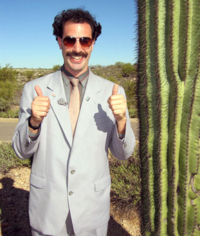
Borat The hit movie Borat: Cultural Learnings of America for Make Benefit Glorious Nation of Kazakhstan takes tastelessness to new extremes in a relentless skewering of contemporary American (and Kazakhstanian) culture. Swept up in the “mocu-mentary” is National Speakers Association member Patrick Haggerty who appears early in the movie coaching Borat in American humor. Associated Press reports that Haggerty

agreed to be filmed for what he thought was a benign documentary on his client’s journey across America. He hurriedly signed a release form, was paid $400, and the lesson began.

As cameras rolled, his client told raunchy stories in garbled English and laughed heartily at the expense of handicapped people. “And then, I’m starting to smell a rat,” Haggerty told The Associated Press. “Each passing minute I’m going, `You know, this can’t be real.'”

Confused, he ended up playing along. He later figured out _ thanks to his son, an HBO-watching college student _ that he’d been duped.

Duped by Borat.

“They were exercising a First Amendment right,” said Haggerty, adding that he enjoyed the movie. “And this Sacha Cohen guy’s going to make 87 gazillion dollars. You know, good for him. I’m just sorry that he had to do it in such a way that he allowed people to make jerks out of themselves exposing their character flaws.”

Haggerty comes off far better in the movie than some of British comedian’s Sacha Baron Cohen’s other victims: the etiquette coach in the genteel South who has to deal with a dinner guest who does not know how to use a flush toilet; the attendees at a National Mortgage Brokers Convention who are faced with the spectacle of two naked men invading their stage; the members of a Pentecostal Congregation who take Borat at face value as a sinner who must be saved.

Cohen, who has a history degree from Cambridge University, plays the cultural idiot savant to the hilt. It took more courage than book learnin’ to stand in a Rodeo ring in Texas and whip the crowd into a frenzy praising “Premier George Walter Bush’s” war against Muslims in Iraq, stating to loud cheers “We support your war of terror – may George Bush drink the blood of every man, woman and child in Iraq.” And then usurp the US National Anthem with lyrics praising Kazakhstan as the crowd as loudly boos him out of the arena and stallions tumble around him.

It’s an unusual movie that makes you wonder how the actor/director survived filming of some of the scenes. Releasing a live chicken in a New York City subway car while trying to kiss stockbrokers on the mouth is not everyone’s cuppa tea.

As Pat Haggerty would no doubt say “This is a movie your maiden aunt would enjoy … not!”