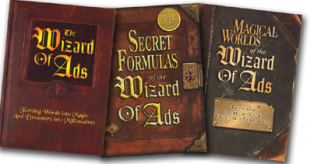
I’ve found inspiration as a speechwriter in the writings of Roy H. Williams. “The Wizard of Adsâ€? brilliantly analyses the impact of advertisements and other forms of communication. His wide-ranging ideas are sourced from fields as varied as neuroscience and historical analysis; mountaineering, religion and art. His three books in the Wizard series are a must-read for anyone interested in the impact of language on audiences, on sharpening their tools of persuasion.
HINT: When reading, mentally find and replace all occurrences of ‘advertising’ and ‘ads’ with ‘speechwriting’ and ‘speeches’. Example:
Speechwriters typically assume that people are seeing and hearing their speeches. Yet rarely is this the truth. In reality, the content of a speech that gushes toward the mind is like a fire hose aimed at a teacup: there’s simply too much coming at us to contain. Most of the information aimed at the brain is deflected, spilled, lost. At the end of the day precious little information is retained.
Will your speech be part of that precious little, or is it being deflected, spilled, lost?
The Journal of Cognitive Neuroscience is a publication read primarily by doctors and medical students who want to understand how human beings recognize and identify objects; use visual mental images; read, produce, and comprehend language; move and store new information in memory; and many other such things. (I think it makes sense for speechwriters to read this stuff, too.)
Modified from Secret Formulas of the Wizard of Ads, p48
Williams does not shy away from deep science to explain business behavior. He’s inspired me to embark on a series of blog entries I’ll categorize as the “Deep End” of speechwriting and public speaking. I plan to undertake an extended journey into academic theories (Sociology; Rhetoric; Criticism; Semiotics) and see what I can find that is of practical use in my day-to-day work as a speechwriter.
I’ll still comment on the “Shallow End” of executive communications and write on the lighter side of life. All work and no play makes Ian a dull boy.