A sister program from OpenAI to ChatGPT which I’ve experimented with is Dall-E2. This does for images what the other program does for text. In response to prompts, it creates realistic images and art. Just as knowledge workers should find out about ChatGPT before it finds them, so graphic designers and illustrators should check out Dall-E2.
I experimented with Ulysses, supplying snippets of the poetic text that stood out for me when I read the novel. Here’s some of the results.
**UPDATE: I ran the same prompts through Midjourney and added the results below. Some are the original 4x results, others were upscaled. I also ran the prompts through Stable Diffusion. It presented 4x results horizontally, and I chose the most appealing.
Dalle2: “Old wall where sudden lizards flash.” (Scylla and Charybdis, p. 194)
Midjourney: “Old wall where sudden lizards flash.”
Stable Diffusion: “Old wall where sudden lizards flash.”
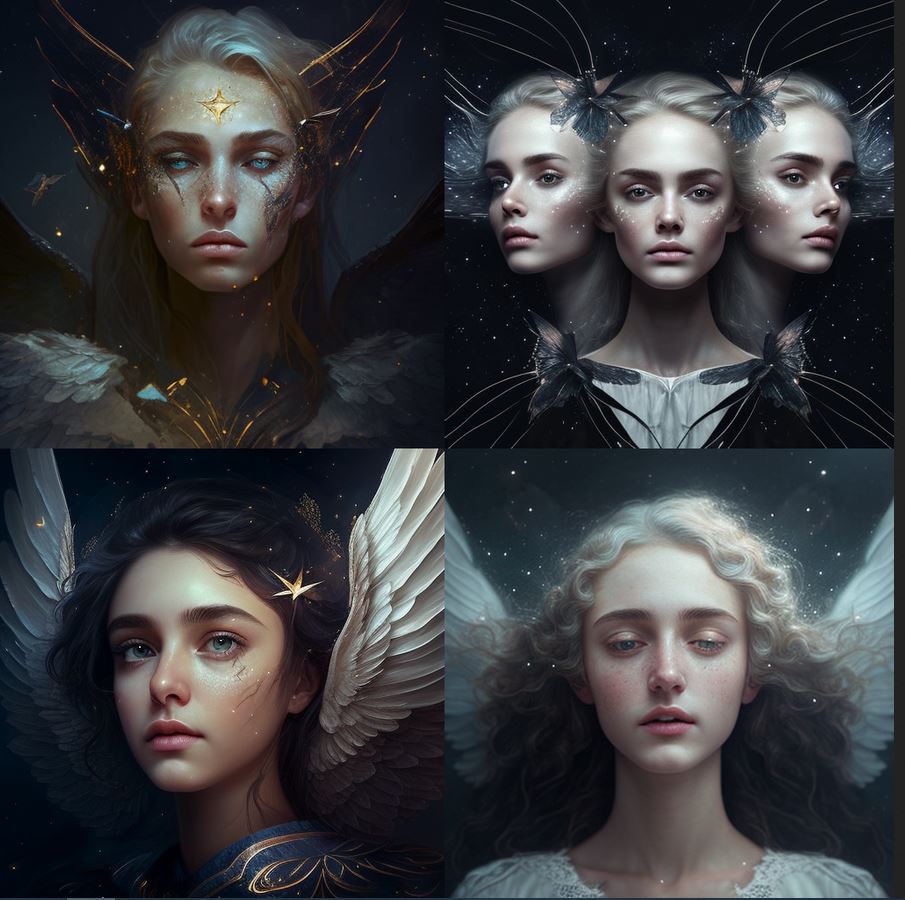
Dalle2: “Where fallen archangels flung the stars of their brows.” (Wandering Rocks, p. 232)
Midjourney (4x): “Where fallen archangels flung the stars of their brows.”
Stable Diffusion: Where fallen archangels flung the stars of their brows.”
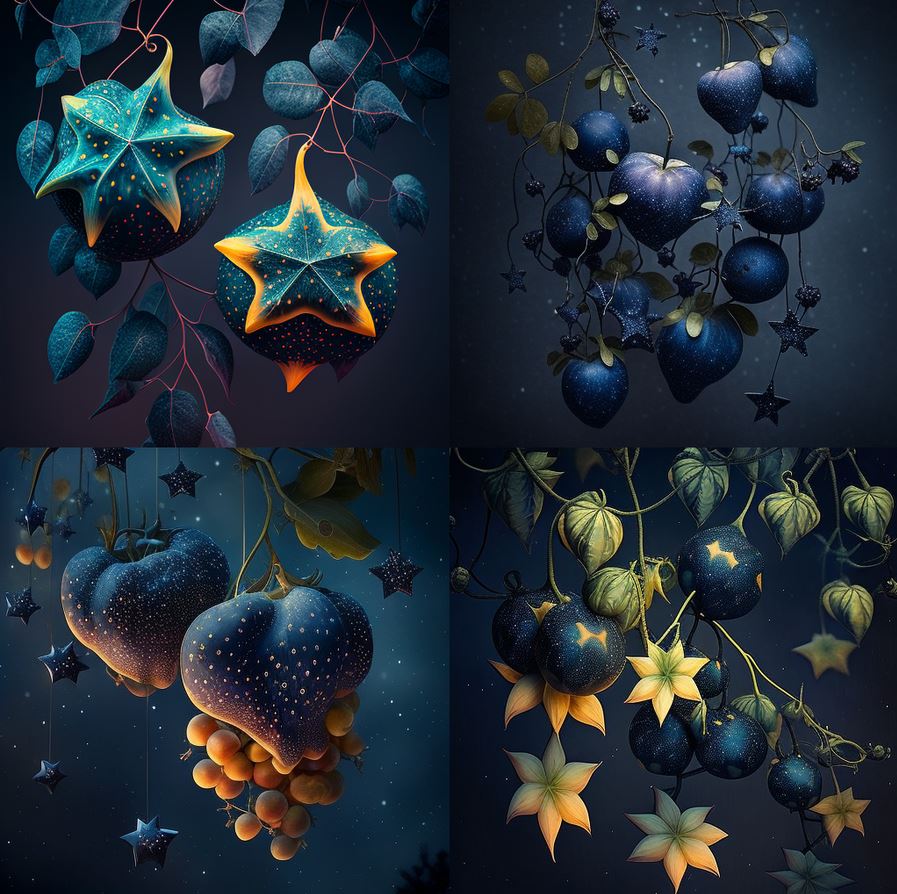
Dalle2: “…stars hung with humid nightblue fruit.” (Ithaca, p. 651)
Midjourney (4x): “…stars hung with humid nightblue fruit.”
Stable Diffusion: “…stars hung with humid nightblue fruit.”
Dalle2: “…the extreme boundary of space…” (Ithaca, p. 680)
Midjourney (4x): “…the extreme boundary of space…”
Stable Diffusion: “…the extreme boundary of space…”
Dalle2: “…past beds of reeds, over slime, mudchoked bottles, carrion dogs.” (Hades, p. 95)
Midjourney: “…past beds of reeds, over slime, mudchoked bottles, carrion dogs.”
Stable Diffusion: “…past beds of reeds, over slime, mudchoked bottles, carrion dogs.”
We’ve entered a new era of computing. Similar to the dawn of the Netscape browser, of Google, and of mp3 music, the availability of ‘chatbot’ software opens new horizons. It’s a tool that some might find useful, others find challenging, and some find offensive.
If you are not familiar with its capabilities, I spent a few minutes (literally, just a few) asking it questions about what many consider one of the most challenging of novels: James Joyce’s Ulysses.
ChatGPT is free to use (login required) and has a simple interface where you can pose questions for an immediate response.
Here’s are the responses to my questions about Ulysses.
** UPDATE (July 11, 2023) Claude 2 is a new chatbot from Anthropic. I asked it to respond to the same prompts. Also note that the original posting from Dec 2022 elicited a set of responses from ChatGPT that were significantly different from the ones when I re-ran the prompts in July 2023, after ChatGPT 4 was released in March. As developments continue, and given the random nature of repeat prompts, your mileage might vary for both chatbots if you were to run these same prompts.
ChatGPT:
Q: Write a 100 word introduction to James Joyce’s Ulysses.
“Ulysses” by James Joyce is a literary masterpiece that redefines the boundaries of the novel. Published in 1922, it follows the lives of Leopold Bloom, Molly Bloom, and Stephen Dedalus over the course of a single day in Dublin, Ireland. Joyce’s innovative narrative techniques, including stream of consciousness and multiple perspectives, provide a deep exploration of the characters’ inner thoughts and emotions. Set against the backdrop of Dublin in the early 20th century, “Ulysses” delves into themes of identity, sexuality, religion, nationalism, and the human condition. It remains a complex and influential work that challenges and captivates readers with its linguistic virtuosity and profound insights.
Claude:
Here is a 100 word introduction to James Joyce’s novel Ulysses:
Ulysses is considered one of the most important works of modernist literature. First published in 1922, the novel chronicles a single day – June 16, 1904 – in the life of Leopold Bloom in Dublin, Ireland. Drawing on Homer’s Odyssey, Joyce crafts a complex narrative through 18 episodes that follow Bloom on his odyssey through Dublin. Through experimental literary techniques like interior monologue and stream of consciousness, Joyce explores complex themes of identity, nationalism, religion, and more. Despite initial controversy over its frank depictions of sexuality, Ulysses is now hailed as a groundbreaking masterpiece of 20th century fiction.
ChatGPT & Claude (no significant difference)
Q: List the chapters of James Joyce’s Ulysses
James Joyce’s Ulysses is divided into 18 chapters, also known as “episodes,” each of which is associated with a specific episode from Homer’s Odyssey:
Telemachus
Nestor
Proteus
Calypso
Lotus Eaters
Hades
Aeolus
Lestrygonians
Scylla and Charybdis
Wandering Rocks
Sirens
Cyclops
Nausicaa
Oxen of the Sun
Circe
Eumaeus
Ithaca
Penelope
Each of these chapters is further divided into smaller sections, and the novel as a whole covers a wide range of themes and subjects, including love, loss, identity, and the human condition.
ChatGPT:
Q: Tell me more about 1.
Chapter 1 of “Ulysses” is titled “Telemachus.” It serves as the opening episode of the novel and introduces the character of Stephen Dedalus, who was also the central character in Joyce’s earlier work, “A Portrait of the Artist as a Young Man.” Here are some key details about Chapter 1:
Setting: The chapter is set in a Martello tower located in Sandycove, a seaside town near Dublin, Ireland. The tower itself is a historical fortification.
Characters: The primary characters in this episode include Stephen Dedalus, Buck Mulligan, and Haines. Stephen is a young artist and intellectual, while Buck Mulligan is a boisterous and irreverent friend of Stephen’s. Haines is an English student staying in the tower.
Themes: “Telemachus” explores themes of identity, religion, and authority. The dynamic between Stephen and Buck Mulligan highlights their contrasting perspectives on religion, as well as Stephen’s struggle to establish his own identity and distance himself from the influence of others.
Mythological Allusions: The chapter’s title, “Telemachus,” refers to the son of Odysseus in Homer’s “Odyssey.” Telemachus embarks on a journey to find his father and assert his own identity. This allusion sets the stage for Stephen’s own journey of self-discovery throughout the novel.
Writing Style: Joyce’s distinctive writing style is evident in Chapter 1. The narrative combines descriptions of the physical surroundings with internal monologues, stream-of-consciousness passages, and the use of multiple perspectives. The prose is rich with symbolism, wordplay, and references to literature and history.
Symbolism: The Martello tower itself can be seen as a symbol of the cyclical nature of history and the passage of time. It also serves as a metaphorical starting point for Stephen’s personal odyssey and his quest for artistic and intellectual fulfillment.
“Telemachus” sets the tone for the novel, establishing the themes, characters, and narrative style that will be further developed in subsequent chapters. It presents readers with a glimpse into Stephen Dedalus’s world and introduces the complexities of his relationships and inner struggles.
Claude:
Here’s a brief summary of the first episode/chapter “Telemachus” in Ulysses:
This episode takes place in the morning at Martello Tower where Stephen Dedalus lives.
The title refers to Telemachus, Odysseus’s son in Homer’s Odyssey, drawing a parallel between Stephen and Telemachus.
It introduces Stephen Dedalus, a young teacher and aspiring writer, as one of the central characters.
Through interior monologue and discussions with his roommate Buck Mulligan, we learn about Stephen’s life, his strained relationship with his family, his ideas about religion and nationalism, and his role as an outsider in Irish society.
Important themes that emerge include mothers, Catholicism and apostasy, Irish history and politics.
The narrative style is experimental, with fluid, poetic prose reflecting Stephen’s interior thoughts.
This episode establishes parallels between Stephen Dedalus and Leopold Bloom, who is introduced in the next episode, as two wandering figures in Dublin, giving a sense of the odyssey to come.
ChatGPT:
Q: Tell me more about 2.
Chapter 2 of “Ulysses” is titled “Nestor.” In this episode, the narrative shifts focus from Stephen Dedalus, who was the central character in the first chapter, to Stephen’s interactions at the school where he teaches. Here are some key aspects of Chapter 2:
Setting: The chapter is primarily set at the school where Stephen works as a teacher. The school is located in Dalkey, a suburb of Dublin.
Characters: Alongside Stephen, the chapter introduces Mr. Deasy, the headmaster of the school, who engages Stephen in conversations about various topics. Other characters include schoolboys and staff members who make brief appearances.
Themes: “Nestor” delves into several themes, including history, Irish identity, and the burden of the past. Mr. Deasy, a figure obsessed with history and politics, imparts his views on Ireland’s history and its struggle for independence to Stephen, leading to discussions about national identity and the role of the Irish in society.
Historical Context: Mr. Deasy’s discussions with Stephen reflect the political climate of the time. The chapter is set in 1904, a period marked by ongoing tensions between Ireland and England, as well as the desire for Irish independence. These themes of history and politics play a significant role in shaping the narrative and character interactions.
Symbolism: The title “Nestor” alludes to the character in Homer’s “Odyssey.” Nestor was an aged and wise advisor to the Greek hero Odysseus, known for his stories and lessons from the past. The chapter’s title suggests that Mr. Deasy, as a mentor figure, embodies the role of Nestor, imparting his knowledge and opinions to Stephen.
Writing Style: Like the rest of the novel, Chapter 2 showcases James Joyce’s unique writing style. It includes intricate descriptions, internal monologues, and shifts in perspective. The text features both direct dialogue and stream-of-consciousness passages, adding depth and complexity to the narrative.
Through “Nestor,” Joyce continues to explore the themes and characters introduced in the first chapter while introducing new elements. The chapter serves as a platform for Stephen Dedalus to grapple with historical and nationalistic ideas, setting the stage for further development of his character throughout the novel.
Claude:
Here are some key details about the “Nestor” episode which is the second chapter of Ulysses:
The chapter title refers to the wise king Nestor in Homer’s Odyssey. This draws a parallel between the mentor-student relationship of Nestor and Telemachus and the characters in this episode.
It focuses on Stephen Dedalus, who is now teaching a history class at a boys’ school in Dublin.
Through teaching, conversing with the headmaster Mr. Deasy, and interior monologue, we learn more about Stephen’s ideas on history, education, and Ireland.
Important motifs are introduced like Shakespeare’s Hamlet, a recurrent touchstone for Stephen.
The narrative style continues to be poetic and cerebral, evoking Stephen’s internal thought processes.
Mr. Deasy represents nationalist, anti-Semitic attitudes that Stephen disagrees with, highlighting his role as an outsider in Irish society.
The chapter ends with Stephen receiving his pay and wandering off, paralleling the wandering journeys of Homer’s characters.
There are parallels drawn between Stephen Dedalus and Leopold Bloom, two “nestors” or mentors in their own way.
And so on, through to the final
ChatGPT:
Q: Tell me more about 18.
Chapter 18 of “Ulysses” is titled “Penelope,” and it serves as the novel’s final chapter. This episode is unique in that it is entirely narrated by Molly Bloom, the wife of Leopold Bloom, and it takes the form of a stream-of-consciousness monologue. Here are some key details about Chapter 18:
Perspective: “Penelope” provides readers with a rare insight into Molly Bloom’s inner thoughts, desires, and memories. The chapter is presented as a continuous flow of her consciousness, without traditional punctuation or paragraph breaks, mimicking the spontaneous nature of her stream of thoughts.
Monologue Structure: The chapter is structured as a soliloquy or interior monologue, allowing Molly Bloom to freely express her feelings, reflections, and memories. She reflects on her life, her relationships, and her experiences, ranging from her childhood to her marriage with Leopold Bloom.
Intimacy and Sexuality: “Penelope” is known for its explicit exploration of Molly’s sexual desires and experiences. The chapter delves into her memories of past lovers, including her affair with Blazes Boylan, and her sensual musings about her relationship with Bloom.
Feminine Perspective: Molly Bloom’s monologue presents a distinctively feminine voice and perspective in a novel largely dominated by male perspectives. Through her thoughts and memories, Molly challenges societal expectations of women and asserts her own agency and desires.
Symbolism: The title “Penelope” alludes to the mythological figure from Homer’s “Odyssey.” Penelope, the wife of Odysseus, remained faithful to her husband during his long absence. Molly Bloom, similarly, reflects on fidelity and her own faithfulness within her marriage, as well as her desires for independence and fulfillment.
Language and Style: The chapter is characterized by its unique and often fragmented language, reflecting the spontaneity of Molly’s thoughts. Joyce employs a wide range of linguistic devices, including alliteration, wordplay, and phonetic spelling, to capture Molly’s voice and create a sense of immediacy.
“Penelope” serves as a powerful conclusion to “Ulysses” by giving voice to Molly Bloom, a character who had previously been presented through the perspectives of others. It offers readers a deeply intimate and introspective view of Molly’s inner world, her sexuality, and her thoughts on love and life. The chapter’s unconventional style and exploration of female subjectivity make it a significant contribution to the novel’s themes and narrative structure.
Claude:
Here are some key details about the final episode “Penelope” in Ulysses:
The title refers to the wife of Odysseus who waits faithfully for his return in The Odyssey. This casts the episode’s focus, Molly Bloom, as a Penelope figure.
It consists of Molly’s unpunctuated stream of consciousness as she lies in bed next to her husband Leopold Bloom.
Molly’s rich, unfiltered thoughts flow freely over memories of her youth, her career as a singer, her affair, her relationship with Bloom, and broader meditations on life, love and womanhood.
The narrative style is extremely innovative for the time, featuring Molly’s direct interior monologue over 8 lengthy sentences.
Molly contradicts herself, confused emotions, changes topics rapidly, in a way that realistically captures the flow of thoughts.
The episode is known for being one of the most extensive descriptions of female experience in modernist literature.
Molly is established as a parallel to Penelope – sensual, intelligent, complex. Her final affirmation of “yes” is seen as redemptive and life-affirming.
The novel comes full circle with Molly echoing Bloom’s thoughts from the start, uniting many themes and motifs.
On a somewhat more sophisticated level…
ChatGPT::
Q: I love James Joyce’s Ulysses. Please tell me what storytelling frameworks or persuasive communication techniques are behind it.
James Joyce’s novel “Ulysses” is a highly complex and experimental work that defies traditional storytelling frameworks. However, it incorporates various persuasive communication techniques that contribute to its literary impact. Here are some elements that enhance its persuasive power:
Stream of Consciousness: “Ulysses” is known for its innovative use of stream of consciousness narrative technique. By delving deep into the minds of the characters, Joyce presents their thoughts, impressions, and associations in a free-flowing manner. This technique immerses the reader in the characters’ experiences and creates a sense of intimacy, making the narrative more persuasive and relatable.
Multiple Perspectives: The novel presents multiple perspectives and narratives, often shifting between characters and their subjective experiences. This technique allows readers to see events and situations from different viewpoints, challenging preconceived notions and encouraging empathy. By offering diverse perspectives, Joyce broadens the reader’s understanding of the human condition and enhances the persuasive impact of the work.
Intertextuality: “Ulysses” is rich with intertextual references, drawing from various literary, mythological, and historical sources. Joyce weaves these references into the narrative, creating layers of meaning and allusion. This intertextuality invites readers to engage with the text on multiple levels and rewards those familiar with the referenced works. It adds depth and complexity to the storytelling, making it intellectually stimulating and persuasive.
Symbolism and Allegory: Joyce employs extensive symbolism and allegory throughout the novel. Objects, events, and characters often carry symbolic weight, representing larger themes or ideas. This technique encourages readers to interpret and analyze the text, allowing for personal and subjective connections. Symbolism and allegory add layers of meaning and evoke emotional responses, enhancing the persuasive impact of the narrative.
Linguistic Playfulness: Joyce experiments with language, employing puns, wordplay, and unconventional sentence structures. This linguistic playfulness engages readers on a linguistic level, challenging their perception of language and encouraging active participation. It creates a sense of delight and intellectual stimulation, enhancing the persuasive power of the work by captivating the reader’s attention.
Social Commentary: “Ulysses” offers social commentary on various aspects of early 20th-century Dublin society, including politics, religion, sexuality, and gender roles. Through the portrayal of characters and their interactions, Joyce critiques societal norms and highlights hypocrisy, inequality, and the complexities of human behavior. This social commentary challenges readers to question prevailing ideas and consider alternative perspectives, making it persuasive in its ability to provoke critical thinking.
While “Ulysses” does not conform to traditional storytelling frameworks, it incorporates persuasive communication techniques such as stream of consciousness, multiple perspectives, intertextuality, symbolism, allegory, linguistic playfulness, and social commentary. These techniques contribute to its enduring impact as a complex and thought-provoking work of literature.
Claude:
James Joyce utilizes several innovative narrative techniques and frameworks in Ulysses that make it such a pioneering modernist novel:
Stream of consciousness – Joyce’s use of interior monologue to depict the continuous flow of characters’ unfiltered thoughts and impressions was revolutionary. It captures the psychic experience in a more realistic way.
Characterization – Rather than traditional character development, characters like Leopold Bloom are revealed through a collage of memories, thoughts, and sensory impressions. This technique adds psychological depth.
Parallels to myth – Drawing parallels between contemporary Dublin and Homer’s Odyssey adds layers of meaning and universal themes to the mundane events depicted.
Linguistic experimentation – Joyce plays with language, manipulating structure, rhythm and inventing compound words to convey meanings in new ways. This linguistic innovation immerses the reader in characters’ minds.
Motifs and symbolism – Recurring images, symbols, and metaphors, like “Parallax” in the Ithaca episode, tie together the novel’s overarching themes.
Non-linear time – Joyce’s novel manipulates time by transgressing conventional chronology. This requires active reading to piece together the timeline.
Rhetorical devices – The novel makes skilled use of devices like irony, puns, allusions and rhetorical questions to add layers of meaning.
By breaking conventions, Joyce revolutionized the art of storytelling and persuasive communication in literature. Ulysses expanded the boundaries of language and form to depict human consciousness like no other modern novel.
ChatGPT:
Q: What is the relationship between the main characters in James Joyce’s Ulysses?
In James Joyce’s Ulysses, the main characters are Leopold Bloom, Stephen Dedalus, and Molly Bloom. The relationship between these characters is complex and multifaceted, and it evolves over the course of the novel.
Leopold Bloom is a middle-aged Jewish man who works as an advertising canvasser and lives in Dublin with his wife, Molly. Stephen Dedalus is a young artist and intellectual who is struggling to find his place in the world. The two men are initially strangers, but their paths intersect on several occasions throughout the course of the novel, and they eventually develop a friendship of sorts.
Molly Bloom is the wife of Leopold Bloom and the mother of their daughter, Milly. She is a strong-willed and intelligent woman who is deeply unhappy in her marriage and has had a number of affairs. Despite this, she remains devoted to her husband and her family.
Throughout the novel, the relationships between these three characters are explored and tested in various ways, as they each struggle with their own desires, fears, and insecurities. Despite the challenges they face, they are ultimately united by their shared humanity and their desire to find meaning and connection in their lives.
Claude:
The main characters in James Joyce’s Ulysses are Leopold Bloom, Stephen Dedalus, and Molly Bloom. Here’s an overview of the key relationships between them:
Leopold Bloom and Stephen Dedalus:
Although from different generations and backgrounds, Bloom and Stephen are both outsiders in many ways within Dublin society.
Bloom takes on a fatherly, mentoring role with Stephen, as seen when they wander Dublin together in later episodes.
Some scholars see their relationship as symbolic of finding meaning through human connection amidst isolation.
Both are thoughtful intellectuals, but with different dispositions – Stephen’s youthful idealism and Bloom’s humane pragmatism.
Their interactions, like debating Shakespeare in the library episode, reveal differences but also meaningful exchange of ideas.
Leopold Bloom and Molly Bloom:
Married for many years, their relationship has ups and downs, disagreements but also deep love and attraction.
Bloom tolerates Molly’s affair with Blazes Boylan with compassion.
Molly and Bloom complement each other – her vivaciousness and his thoughtful restraint.
Bloom cherishes memories of tender moments with Molly, revealing his sentimental side.
The final Molly monologue conveys her emotional dependence on her ‘Poldy’ Bloom.
Their mutual compassion and Molly’s decisive “Yes” affirms their relationship.
The relationships reveal the meaningful human connections possible between individuals from differing worlds. Despite conflicts, their care for each other shines through.
And, at a deeper level:
ChatGPT:
Q: How does James Joyce explore the relationship between the Austro-Hungarian Empire and Ireland in his novel Ulysses?
While James Joyce’s “Ulysses” primarily focuses on the events and characters in Dublin, Ireland, the novel does touch upon the relationship between the Austro-Hungarian Empire and Ireland indirectly. Here are a few ways Joyce explores this relationship in the novel:
Historical Context: The timeframe of “Ulysses” is June 16, 1904, which coincides with the decline of the Austro-Hungarian Empire. The empire, comprising various ethnic and cultural groups, was facing growing tensions and nationalist movements. While not explicitly depicted in the novel, this historical context may inform the characters’ perspectives and the overall atmosphere of the time.
Imperialism and Nationalism: Joyce’s exploration of nationalism and identity in “Ulysses” can be seen as indirectly related to the themes of imperialism and national movements. Ireland, as a colonized nation under British rule, struggled for independence during this era. The novel examines Irish national identity and the aspirations for self-determination, which can be seen as part of the broader landscape of imperial politics and nationalism.
Historical References: Throughout the novel, Joyce includes allusions and references to various historical events, figures, and political situations. While these references are not explicitly tied to the Austro-Hungarian Empire, they contribute to a broader exploration of the political and cultural context of the time. Joyce’s use of historical references adds depth and complexity to the narrative, reflecting the interconnectedness of various geopolitical events and ideologies.
It’s important to note that “Ulysses” primarily focuses on the lives and experiences of its characters in Dublin, and Joyce’s exploration of the Austro-Hungarian Empire in relation to Ireland is more indirect and subtle. The novel’s primary focus is on the interior lives of the characters and their interactions within the Irish context.
Claude:
James Joyce explores the complex relationship between the Austro-Hungarian Empire and Ireland in subtle yet significant ways throughout Ulysses:
Leopold Bloom is a Hungarian Jew who has immigrated to Ireland, bringing an outsider’s perspective that contrasts with Irish nationalism. His foreign identity makes him a target for anti-Semitic sentiment.
Joyce links the empires through symbolism like the Russian General’s letter, which destabilizes Stephen’s nationalist views by highlighting Ireland and Hungary’s parallel subjugation.
Characters like Mr. Deasy criticize Hungarian presence in Ireland through ethnic stereotypes, representing nationalist anxieties around the empire’s influence.
Musical references to the Austro-Hungarian composers throughout the novel foreground the empire’s cultural imprint on Dublin.
The multiethnic makeup of the Austro-Hungarian empire is mirrored in the diversity of Dublin’s residents, suggesting shifting demographics and pluralism.
Bloom’s ambivalence about his national identity – neither fully Hungarian nor Irish – echoes the instability of ethnic boundaries under the empire.
Ireland’s colonial domination by Britain parallels Hungary’s status within the Austro-Hungarian empire, a connection Joyce subtly draws.
Linguistic traces, like Hungarian words and names, highlight the diasporic mixing of languages and cultures in Dublin.
Through these complex means, Joyce represents the postcolonial liminal space Dublin inhabits between empire and nationalism, using Hungarian-Irish identity to destabilize facile binaries.
Once more, with feeling:
ChatGPT:
Q: What feelings does James Joyce’s Ulysses elicit in readers?
James Joyce’s Ulysses is a complex and challenging novel that can elicit a wide range of feelings in readers. Some readers may find the novel intellectually stimulating and emotionally resonant, while others may find it dense, confusing, or even frustrating.
One feeling that many readers may experience while reading Ulysses is admiration for Joyce’s technical skill and artistic vision. The novel is known for its innovative and experimental style, which includes stream-of-consciousness narration, symbolism, and a wide range of literary and cultural references. Many readers may be struck by Joyce’s ability to create a rich and immersive world through his writing, and they may be impressed by the depth and complexity of his characters and themes.
At the same time, some readers may find Ulysses to be emotionally challenging or unsettling. The novel deals with a wide range of themes, including love, loss, identity, and the human condition, and it often portrays these themes in a raw and unflinching way. As a result, some readers may feel moved, saddened, or even disturbed by the novel’s portrayal of these themes.
Ultimately, the feelings that Ulysses elicits in readers will depend on their individual experiences, perspectives, and expectations, and there is no one “right” way to feel about the novel.
Claude:
James Joyce’s Ulysses tends to elicit a wide range of feelings and reactions in readers, some of the most common being:
Frustration – The novel’s difficulty, obscure allusions, and tangled language can frustrate readers initially. The nonlinear narrative and dense style requires patience.
Curiosity – Joyce’s innovative literary techniques pique many readers’ interest and curiosity even amid confusion. The novel provokes a desire to unpack its meanings.
Appreciation – Many readers feel a profound appreciation for Joyce’s artistry in capturing the intricacies of human thought and experience through his modernist style.
Accomplishment – Upon completing Ulysses, many readers feel a huge sense of personal accomplishment given the dedication required to finish this complex work.
Immersion – Readers often feel completely immersed in the world of 1904 Dublin that Joyce’s vivid, sensory details bring to life. The characters feel palpably real.
Engagement – Ulysses actively engages readers’ intellect but also elicits emotional engagement through relatable characters like Leopold and Molly Bloom.
Inspiration – The novel’s expansive vision of human consciousness and innovative prose often inspires awe and creative excitement in readers.
While Ulysses is undeniably challenging, its rich language, psychological depth, and bold experiments in style offer profound rewards if readers are willing to immerse themselves in Joyce’s monumental literary achievement.
Comparing ChatGPT and Claude:
While the two chatbots give differing answers, I was also aware that there is variation from the same chatbot when asked to either re-do the same prompt (giving the user a chance tio vote on the preferred response) as well as asking over time. This was clear then ChatGPT was first quizzed in December compared to July — a much more comprehensive and accurate response was achieved currently and the content above is from July.
Neither tool was 100% accurate. Examples of minor ‘hallucinations’ (as misinformation from LLMs is termed) include:
ChatGPT:
Episode 1: The Martello tower itself can be seen as a symbol of the cyclical nature of history and the passage of time.
While the tower could be symbolic (as, for example “the omphalos – a Greek term that can either mean a belly button or the center of the world itself”) the cyclical nature of history in Ulysses is more often attributed to Joyce’s reading of Giambattista Vico, who in The New Science and his other works theorized on a concept he called “corsi e ricorsi” or a cyclical theory of history. This is not apparent in the setting or architecture of the Martello tower as it is elsewhere in the novel.
Claude:
Episode 1: This episode establishes parallels between Stephen Dedalus and Leopold Bloom, who is introduced in the next episode, as two wandering figures in Dublin, giving a sense of the odyssey to come.
This is an illogical foreshadowing of the *eventual* parallels between the two protagonists. But, since Bloom has yet to be introduced, and Stephen has yet to commence his “wandering”, the claim that the first episode established any relationship between the two is patently false.
Overall:
The responses from ChatGPT 4 are far superior to those returned in December and close to 100% accurate apart from the one example above. However, Claude has made a number of dubious claims:
On the relationship between Stephen Dedalus and Leopold Bloom:
interactions, like debating Shakespeare in the library episode, reveal differences but also meaningful exchange of ideas.
There is absolutely*no* interaction between the two in Scylla and Charybdis. Bloom anonymously slips out of the library at the end of the episode, and Mulligan remarks on “the wandering jew.” Stephen’s debates with his interlocutors — Eglinton and Russell.
On the relationship with the Austro-Hungarian empire:
Joyce links the empires through symbolism like the Russian General’s letter, which destabilizes Stephen’s nationalist views by highlighting Ireland and Hungary’s parallel subjugation.
Characters like Mr. Deasy criticize Hungarian presence in Ireland through ethnic stereotypes, representing nationalist anxieties around the empire’s influence
The only “Russian General” I could find mention of in Joycean literature is from Finnegan’s Wake where a solider hesitates to shoot a Russian General who is about the defecate.
Mr. Deasy holds strong anti-Semitic views, but does not have an opinion on Hungarians — of whom the only one we hear about with a ‘presence in Ireland’ was Leopold Bloom’s father.
However, the other points about Bloom’s ambivalent identify and Ireland’s colonial domination by Britain paralleling Hungary’s status are spot on.
In conclusion
I would like to emphasize that the responses to the questions above were created entirely by ChatGPT and Claude.. My sole contribution (as someone who has read Ulysses and knows enough about the novel to ask the right questions) was to create the prompts that the AI system processed.
While there might be room to edit the answers, they do, overall, present accurate information. Examples of mistakes show that were someone to turn this in as an essay, unedited, to their professor, their deception would become immediately apparent.
However, I ‘created’ this content in under 15 minutes. A few minor edits and it’s flawless. And much more succinct than Googling ‘a summary of Ulysses’
I’d recommend that you take these chatbots for a spin in your area of expertise and see what you find. If you make you living as a content creator (speechwriter, blogger, essayist or other knowledge worker) you owe it to yourself to become acquainted with this new tool. You might be up against it in the near future.
If you are a college or high school teacher who grades student essays, good luck!
(with apologies to The Proclaimers, Bruce Springsteen, and Bob Dylan)
Here’s some midnight ramblings from the 36 hours I spent in bed after contracting COVID flying back from Europe among the great unmasked who airlines welcome on board these days. Although we kept our masks on for the journey, my wife Sandra & I had to remove them to eat and drink. So, thanks go to the snuffling, unmasked, Irishman in the window seat next to us who passed on his germs, five days later, we both tested positive.
Sandra was able to function. Me, I spent a couple of days and nights in bed, unable to speak, my throat hurt so bad.
Writing lyrics to a COVID Rock Opera from the songs that got me through the night kept me amused. In the cold light of day, they’re probably nothing more than a false creation, proceeding from a heat-oppressed brain. But they kept me amused. Your mileage may vary.
(And yes, we’re both well on the road to recovery.)
Act One (To the tune ‘Oh Jean’ by The Proclaimers, sung in a broad Glaswegian accent)
Ya went through half the human race Ta getta me Ya went through half the human race Ta getta me.
I used to think Ya’d never find me That I was safe From your embrace But COVID, oh COVID You got lucky with me.
I was so wrong What took ya so long? Ya gotta to me ‘cos you could Like ya always said ya would. Ah COVID, oh COVID You got lucky with me.
And now I know What it means To have ya all over me Like others do From Wuhan to Crewe But COVID, oh COVID Ah got lucky with you.
Ya went through half the human race Ta getta me Ya went through half the human race Ta getta me.
Act Two (no need for many revisions to the lyrics, Bruce Springsteen says it like it is)
I’m on fire At night I wake up with the sheets soaking wet And a freight train running through the middle of my head But COVID, you cool my desire. Sometimes it’s like someone took a syringe baby edgy and dull And put a vial fulla virus in the middle of my skull Oh, oh, oh, I’m on fire
Act Three (From an original song by Bob Dylan, which fits the mood with just a few tweaks.)
COVID didn’t mean To treat you so bad You shouldn’t take it so personal It didn’t mean To make you so sad You just happened to be there, that’s all.
When it saw you take your mask off and smile It thought that it was well understood That you’d be infected in a little while I didn’t know that you were vaccinated for good.
But, sooner or later, one of us must know That COVID just did what it’s supposed to do Sooner or later, one of us must know That it really did try to get close to you.
It couldn’t see What you could show me Your mask had kept your mouth well hid. It couldn’t see How you could know me But you said you knew me and I believed you did.
When it whispered in my ear And asked me if it was infecting you or her It didn’t realize just what I did hear It didn’t realize that both of us were.
But, sooner or later, one of us must know That COVIDs just doin’ what it’s supposed to do Sooner or later, one of us must know That it really did try to get close to you. That you were just kiddin’ me, you weren’t really negative at all An’ it told you, as it clawed out your throat that it Never really meant to do you any harm.
But, sooner or later, one of us must know That COVID just did what it’s supposed to do Sooner or later, one of us must know That it really did try to get close to you.
Fiona Hill burst onto the national, and international, stage when she testified in the 2019 impeachment hearings for President Donald J. Trump.
At the time, British commentators were struck by the woman with a distinctive working-class Northern accent who was an advisor to a US President and senior member of the American foreign policy establishment. The Financial Times referred to her as the “improbable” Fiona Hill. The sting in the tail of her testimony was, for the British establishment, her comment that she felt her background impeded her in the UK in the way it did not in the USA. They wondered how on earth she’d made it from an obscure northern hometown (Bishop Auckland, County Durham) to work in the White House, or, as she puts it in her new book There is Nothing For You Here, “from the coal house to the White House.”
The book is part autobiography, part indictment of the failings of the Trump administration. It embodies the lyrics of the Beatles song, Honey Pie:
She was a working girl North of England way Now she’s hit the big time In the U.S.A.
A coal miner’s daughter
Hill was, literally, a coal miner’s daughter. Born in 1965, her childhood was marred by the decline of the mining industry in the north-east of England. Her father was laid off from the mines and scraped by as a hospital porter. Her lived experience in the region stayed with her as she passed the 11+ exam, survived the challenges of a comprehensive school, made it to St. Andrews University, a scholarship to Harvard, and a stellar career as a fluent Russian-speaking expert the geopolitics of the 21st century and Vladimir Putin.
The book resonated for me because it has echoes of my own path from the north-west of England and the declining industrial town of Crewe to the States. I bailed out of an academic career, but the coincidences, fortuitous meetings, significant mentors, and sheer improbability of life in the USA that Hill notes were also my experience. That, and a shared distaste for what America has become under Trump, were themes in the book that grabbed me.
Populism at home and abroad
Throughout the book, Hill notes how the three countries she has lived and traveled in have embraced populism. The declining industrial areas of the UK are mirrored in the “Rust Belt” regions of the USA and magnified by the collapse of the Soviet Union. Time and again, in ways large and small, she notes how the rise of an authoritarian like Putin is predicated on the same populism exploited by Boris Johnson and Nigel Farage’s Brexit campaign in the UK, and, inevitably, the 45th President of the US.
Her academic background and serious foreign policy chops give rise to analysis and insights that distill the confusion surrounding Trump, Brexit, and Russian influence into clearly understandable themes. When political elites ignore the dispossessed, strongmen take center stage. Here’s one of many passages in the book–worth quoting at length–where Hill analyzes this:
Those who were attracted to the Tea Party and other populist movements were reacting to, and hoping to counter and even reverse, the effects of economic crises and demographic changes. The populists’ supporters were also reacting to and seeking a salve for the intense emotions that these changes and challenges elicited. Major societal changes, especially when they happen rapidly and in combination, help fuel what celebrated scholars of the twentieth century like Fritz Stern called “cultural despair.” Cultural despair is the sense of loss, grievance, and anxiety that occurs when people feel dislocated from their communities and broader society as everything and everyone shifts around them. Especially when the sense of identity that develops from working in a particular job or industry, like my father’s image of himself as a coal miner, also recedes or is abruptly removed, people lose their grip on the familiar. They can easily fall prey to those who promise to put things–including jobs, people, or even entire counties–back in “their rightful place.”
Hence, Hill demonstrates, Brexit, Putin, Trump. The clear and present danger she identifies is the continuation of populism and the emergence of a leader as competent as Putin on the American scene.
In the aftermath of Trump’s disastrous reign, it was tempting to breath a sign of relief. But that would have been premature, because there was no indication that his dynasty would fade away. And American populism looked like it was here to stay–unless we could find a way to mend our social and political divisions.
The “Russia bitch”
The experience of this multi-lingual academic expert in the Trump White House is no surprise, but nevertheless shocking. It follows challenges she’d experienced being mistaken for a high-end prostitute by hotel doormen when attending senior-level meetings in Moscow, discovering her salary as a woman was significantly lower than less qualified male counterparts in academia, and–early in her university days–being dismissed as a ‘common northerner’ by hoity-toity classmates. In the White House Trump’s first words to her were to yell “Hey, darlin’, are you listening?” when he mistook her as the only woman in an Oval Office meeting for a secretary. Later, she heard, staffers and first family members dismissed her as “the Russia bitch.”
She dishes the dirt on how Trump’s view of the world was that of a New York construction boss used to bullying suppliers, his lack of interest in briefing documents, and fragile ego easily exploitable by savvy foreign powers. Her account adds more damning evidence to the likes of Woodward and Costa’s Peril and Leonning and Rucker’s I Alone Can Fix It.
Education
Hill mounts an appeal to expand the opportunities that gave her a ticket out of County Durham, and me a ticket out of Crewe: education as, in the words of the books’ subtitle a way of ‘Finding Opportunity in the 21st Century.’
Absent this, she concludes
These left-behind people deserve better. but their problems are everyone’s. They are our fellow Americans and fellow Brits, in some cases our family members and friends. Helping them will not be purely a selfless act. Because as long as they feel that there is no hope for them, there will be no hope for the rest of us. There will be nothing for us, anywhere.
On a recent episode of the charming Start the Week BBC Radio 4 program we heard Frances Wilson, Salman Rushdie and Simon Armitage discuss the rehabilitation of DH Lawrence and the relationship between the writer and their work. In the closing minutes (approx 37:00) host Andrew Marr asks Armitage about an essay that claims Bob Dylan’s lyrics “don’t really hold up as great poetry, you have to listen to the songs in order to understand the interleaving of the music and the words….can you tell us what you think doesn’t work on the page? Is it repetition, is it sloppiness of the language, evasiveness?”
Armitage responds that in a poem “everything that happens in a poem has to happen within the text, in silence really…it has to be done with the alphabet.” Whereas songwriters can “write the lyric and even ‘la-la-la’ might sound very good if you put it to the right chord progression. It can be utterly transcendent if it’s working well with the music and if you’re wearing the right cowboy boots and if you’ve got the right voice.”
He reports taking Dylan lyrics into his poetry class where younger students (unfamiliar with the tune) might appreciate the poetic aspects, nevertheless see cheesy rhymes, repetition, tautology and other elements “that you can’t get away with on the printed page.”
Speechwriters as songwriters
In many ways Armitage is stating the obvious. Songs are created to be listened to, not read (as rewarding as a close reading of Dylan’s lyrics can be). As with great songs, so with great speeches.
Speechwriting authorities Nancy Duarte and Bob Lehrman drive home the message that speeches (like songs) need to be written for the ear not, (as are poems) for the eye.
Sparklines
Nancy Duarte’s seminal 2010 book Resonate focuses on visual storytelling. With the use of what she calls ‘sparklines’ she graphically illustrates the arc of a speech and maps the emotion and delivery by tracking the laughter and applause alongside the words (lyrics) of great speeches such as Martin Luther King’s “I have a dream” speech. It would be fascinating to apply a sparkline mapping audience reaction to live musical performances.
Political speechwriting
Political pundit and speechwriting professor Bob Lehrman (literally) wrote the book on speechwriting. In examining why persuasive speeches work, he lists the various forms of repetition (anaphora, epistrope, antimetabol, and climatic order) and forms of vivid language (simile and metaphor, understatement and irony) that work on the heartstrings, not just the head space, of the audience.
While these techniques can be employed by poets, they resonate differently when delivered by a compelling speaker.
In the beginning was the word
In claiming that “everything that happens in a poem has to happen within the text, in silence really” Armitage overlooks the pre-literate origins of poetry, when bards of old, the minstrels of Medieval times, recited epic poems which the tellers knew by heart. The literary techniques they used provided aide memoirs for themselves and for their listeners.
Since ancient times, humans have memorized and recited poetry. Before the invention of writing, the only way to possess a poem was to memorize it. Long after scrolls and folios supplemented our brains, court poets, priests and wandering bards recited poetry in order to entertain and connect with the divine.
Sorry, Simon, the origins of the poem are with the word, not the page.
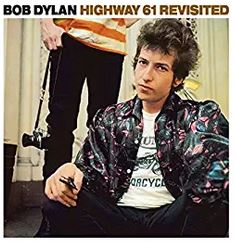
Dylan’s recording of Desolation Row was the longest track (at just over 11 minutes) on his 1965 album Highway 61 Revisited. While I can’t remember the first time I heard it, it’s been in my head for most of my adult life. It’s one of my defining anthems that, together with Roy Harper and Leonard Cohen’s songs, I love more for the lyrics than the melodies. It’s pure poetry set to music.
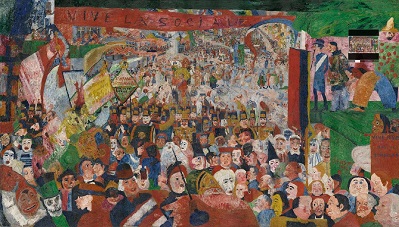
The Getty Museum owns the Ensor painting and paired it with Dylan’s song with it in the book The Superhuman Crew, noting
Ensor’s huge, vibrant, and startling canvas presents a scene filled with clowns, masked figures, and barely visible amid the swirling crowds the tiny figure of Christ on a donkey entering the city of Brussels. “Desolation Row,” from Dylan’s classic 1965 album Highway 61 Revisited, presents its own surreal portrait of modern life in strangely similar terms.
That “surreal portrait of modern life” becomes more appropriate with each passing year. As I listened again to the song I know so well, themes emerged. It is a song rooted in the time Dylan wrote when cracks were appearing in 50s America, and those with open eyes and ears witnessed the “chimes of freedom flashing.”
Dylan sings of the contrast between two world-views: those embracing emerging freedoms and the guardians of the old order. He paints this contrast in both stark black and white terms (Everybody’s shouting, “Which side are you on?!”) as well as shades of grey.
They’re selling postcards of the hanging, they’re painting the passports brown
The dystopian scene is set. Repression, autocracy, and violence rule in a time when hangings were public events. These might be images of lynching’s in the Deep South or scenes from The Handmaids Tale. What sort of society trades in picture postcards of the dead? One where individual identity is subject to a brown-out. Arguments about the color of passports were part of the Brexit debate that consumed Britain. Painting passports is something “they” do to restrict our liberty to travel and escape the dystopia. Internal passports restricted movement in apartheid-era South Africa, North Korea, and modern China.
The beauty parlor is filled with sailors, the circus is in town
Yet, the scene is not monochrome. There’s a rambunctiousness in a world where the sailors (presumably men) fill the beauty parlors, and the circus is in town. Dylan sets the scene in a port city–one he visits again in 1974 when he tells of a man who “Hunts her down by the waterfront docks where the sailors all come in” (Simple Twist of Fate from Blood on the Tracks). What would groups of sailors want in a beauty parlor? More than a haircut. Hello sailor! Perhaps some eye shadow, a waxing, or lip gloss? Anything to juice up their shore leave.
The opening two lines contrast repression with freedom, heralding an awakening sense of personal expression at the dawn of the ’60s. Soon enough, many would choose the option to dance beneath the diamond sky/With one hand waving free (Mr. Tambourine Man--recorded six months earlier.) Meanwhile, the representatives of the old order are on parade, like Shriners striding down Main Street in Anytown, USA.
Here comes the blind commissioner, they’ve got him in a trance
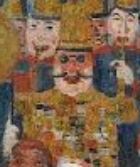
The first of the old order makes an entrance. I see the blind commissioner four rows back in the Ensor painting — the man with the handlebar mustache, center stage. An authority figure (perhaps the port commissioner?) who is both literally and metaphorically blind. Blind like Lady Justice holding her scales. Except “they” (the ones selling postcards of hangings and painting passports) have him in a trance. Hypnotized. In their power. Unable to function.
One hand is tied to the tight-rope walker, the other is in his pants
Not only blind and hypnotized but bound. Guided by the tight-rope walker from the circus, accomplished at balancing in his own way, just as Lady Justice balances her scales. He is leading the blind commissioner, who is all the while pleasuring himself with his free hand. While some might see his free hand resting innocently in a trouser pocket, the words “in his pants” always implied something far raunchier to me — long before Borat filmed the blind commissioner Rudy Giuliani in the hotel room with one hand in his pants.
And the riot squad they’re restless, they need somewhere to go
Three years before the Chicago police riot at the 1968 Democratic Convention and decades before the last US President stirred the restlessness of his own rioting squad and suggested somewhere they could go (down Pennsylvania Avenue and up the steps of the Capitol), Dylan has the measure of the inherent restlessness of the enforcement arm of the old order.
As Lady and I look out tonight, from Desolation Row
Meanwhile, above it all, the poet sits with his “Lady” looking out over the unfolding nighttime scene, not “on” but “from” Desolation Row. The home of the residents of the emerging zeitgeist. I see Desolation Row as the New York apartment Dylan writes about in Visions of Johanna:
Ain’t it just like the night to play tricks when you’re tryin’ to be so quiet? We sit here stranded, though we’re all doin’ our best to deny it
They look out over the dystopian landscape of blind commissioners and riot squads, perched on an island of sanity, observing the crazy world.
Lady is the mythical companion of the Tramp in the Disney film of a decade earlier. Dylan as the Chaplinesque Everyman “Tramp” alongside a woman who might be slumming from the aristocracy in those timeless dystopian times.
Desolation Row might also be a knowing reference to California’s Cannery Row, described by Steinbeck as “a poem, a stink, a grating noise, a quality of light, a tone, a habit, a nostalgia, a dream.” The sardine industry had collapsed, in desolation, a decade before Dylan wrote his song. Cross-referenced with Jack Kerouac’s Desolation Angels, which declared, “Everything’ll be all right, desolation is desolation everywhere and desolation is all we got and desolation ain’t so bad.”
Cinderella, she seems so easy, “It takes one to know one,” she smiles And puts her hands in her back pockets Bette Davis style
Alongside Lady, Cinderella is another Disney character, an archetype of emerging freedom. She is ignored by her establishment sisters, standing free, knowing the power of her sexuality. A woman who only “seems so easy” (as in easy to seduce, or perhaps at her ease?) acknowledging others (like Dylan?) who hold the same appeal. Insouciant, seductive, captivating. Someone who would have turned heads in the folk clubs of Greenwich Village.
And in comes Romeo, he’s moaning. “You Belong to Me I Believe” And someone says, “You’re in the wrong place, my friend, you’d better leave.”
Cinderella’s anthesis arrives on the scene. Romeo sans Juliet, desperate to own whatever woman he can find. Down on his luck, off his game, and “moaning.” A visitor from the dark side. His inappropriate advances earning a rebuke–not only to put him in his place but to tell him, with the threatening tone of a nightclub bouncer or mobster’s bodyguard, that he needs to leave. The two lines of dialog tied together in rhyme are polar opposite in intention. Those who claim ownership (capitalists, The Man?) having no place in the communal world of Desolation Row.
And the only sound that’s left after the ambulances go Is Cinderella sweeping up on Desolation Row.
And so we come to the end of Act One. The sirens are silenced. The riot squad has done its worst. Chaos has reigned off-screen. We’re witness to the cleaning-up operations, with Cinders doing what her stepmother required — sweeping up the broken glass on the street. Indeed, it must be broken glass. After all, if it was just the
empty bottles, sandwich papers, Silk handkerchiefs, cardboard boxes, cigarette ends Or other testimony of summer nights.
The Waste Land, Fire Sermon, lines 177-178
of Eliot’s Fire Sermon, we wouldn’t hear her at work.
Now the moon is almost hidden, the stars are beginning to hide
The night is growing darker, colder, older. Clouds are moving in.
The fortune-telling lady has even taken all her things inside
Another circus refugee has called it a night, signaling the transition from one part of the day to another. Her tarot cards, crystal ball, and tasseled gown are now inside whatever she calls home – gypsy caravan, tent, or tenement building. Minus the fortune teller, the future is an unknown.
All except for Cain and Abel and the hunchback of Notre Dame / Everybody is making love or else expecting rain
But wait, not everyone has quit the scene. Three more archetypes of the old order are introduced. The brothers from the Bible and Quasimodo –monsters in their own way–are the exception to others, engaged in the trivial and the profound. When is making love as trivial as expecting rain? Family members from my English childhood often commented on the weather. They rarely spoke about lovemaking. Depending on which group of people this describes the juxtaposition either challenges the romantic ideal of lovemaking as no more significant an option than commenting on the weather (“Do you want to make out or put on your Wellingtons? It’s all the same to me…”) or the hipsters are making love while the squares look to the cloudy sky. Dylan is unclear about which “everybody” it is — everybody in the apartment, everyone on the street, or the whole world? Shades of grey.
And the Good Samaritan, he’s dressing, he’s getting ready for the show He’s going to the carnival tonight on Desolation Row
Again, a contrast. While the fratricidal boys in the Bible represent murder and martyrdom, the Good Samaritan signifies freedom, preparing for the evening’s entertainment (the night is young). Whether the “show” is something the circus is putting on or the carnival Ensor painted is unclear. However, Desolation Row seems like the fun side of town, more benign than the disorder in the debris-filled streets.
Ophelia, she’s ‘neath the window for her I feel so afraid On her twenty-second birthday she already is an old maid To her, death is quite romantic she wears an iron vest Her profession’s her religion, her sin is her lifelessness And though her eyes are fixed upon Noah’s great rainbow She spends her time peeking into Desolation Row.
Switching back to Shakespearean archetypes, Dylan notices Ophelia beneath the window (that Lady and he looks out of, standing where Romeo would have wooed his Juliet on her balcony). He’s empathetic, concerned, aware of the limitations playing out in her young life. A tragic career woman (her profession’s her religion), she is a lifeless “old maid” — one of Shakespeare’s ‘cold maids’ in Ophelia’s death scene:
Thereis a willow grows aslant a brook
That shows his hoar leaves in the glassy stream.
There with fantastic garlands did she come
Of crowflowers, nettles, daisies, and long purples,
That liberal shepherds give a grosser name,
But our cold maids do “dead men’s fingers” call them
Hamlet, Act 4, Scene 7
She’s fixated on her namesakes’ romantic death, armored against feelings of passion, or trapped like youthful Polio victims in an iron lung? Her goal cemented by Old Testament certainty:
And God said, “This is the sign of the covenant I am making between me and you and every living creature with you, a covenant for all generations to come: I have set my rainbow in the clouds, and it will be the sign of the covenant between me and the earth. Whenever I bring clouds over the earth and the rainbow appears in the clouds, I will remember my covenant between me and you and all living creatures of every kind. Never again will the waters become a flood to destroy all life. Whenever the rainbow appears in the clouds, I will see it and remember the everlasting covenant between God and all living creatures of every kind on the earth.”
Genesis, 9-13
Ophelia is missing the mark, the juice having been squeezed out of her life, denying her true feelings, but trying to make a break, curious about what she’s missing. Despite being an uptight career girl, she can’t help “peeking into Desolation Row.”
This echoes Dylan’s admonition in the opening track on the album (Like a Rolling Stone) to embrace our feelings, recognize our freedoms:
How does it feel, how does it feel? To be without a home Like a complete unknown, like a rolling stone
While there are those like Ophelia who sense the possibility of freedom and might be tempted to overcome their fears to experience it, other sad unfortunates have been destroyed by madness. Among them, as Ginsburg noted, “the best minds of my generation.” (Howl, 1956). What more impressive mind than Einstein?
Einstein, disguised as Robin Hood with his memories in a trunk Passed this way an hour ago with his friend, a jealous monk
Archetypes nest like Matryoshka dolls. The father of relativity, whose theories upended the certainties of space and time itself, now disguised as the folk-hero of Sherwood Forest, robbing from the rich, giving to the poor, accompanied by Friar Tuck. There’s a nod to Einstein’s lot as a refugee, forced to stay in the United States in the 1930s to avoid Hitler’s Germany, who would have no doubt have a store of photographs and diaries from the Europe of his youth in a trunk.
Now he looked so immaculately frightful as he bummed a cigarette And he went off sniffing drainpipes and reciting the alphabet
This heroic figure is down at heel, a hobo like those who rode the rails Dylan’s mentor Woody Guthrie sang about. As disheveled as he might be, he appears “immaculately frightful” (a state of dishabille that perfectly describes a street person I once saw in Paris, where a sense of fashion doesn’t desert those without the means to buy new clothes)—now compelled to neurotically sniff drainpipes and recite the alphabet—a far cry from authoring the Theory of Relativity.
You would not think to look at him, but he was famous long ago For playing the electric violin on Desolation Row.
Just as you’d say about any down-and-out who was once a person of note, “you would not think to look at him, but…” he was once a banker, school principal, a respected member of the community, Nobel Laureate in Theoretical Physics. Or, in the case of a musician like Dylan, a violinist he shared the stage with before things took a turn for the worse.
Dr. Filth, he keeps his world inside of a leather cup But all his sexless patients, they’re trying to blow it up
We now come to one of the central characters on the dark side of the street. Dr. Filth is a name straight out of a Marvel comic book. The leather cup could be an athletic support cup around his manhood that his “sexless patients” are trying to blow (pun intended?). Or it could be a leather liar’s dice cup sitting on a barroom counter that the patients want to dynamite. Anyone who needs to keep their world inside anything as small as a cup must have a paranoid need to keep it safe. Like memories in a trunk, they might well be keepsakes. Or patient records. I wonder what HIPPA regulations require? What insecurities drive this?
Now his nurse, some local loser, she’s in charge of the cyanide hole And she also keeps the cards that read, “Have Mercy on His Soul.”
The doctor’s assistant is “some local loser”—more likely to be found working as a waitress in a greasy spoon or matinee movie theatre attendant than as a qualified nurse. She guards (and administers?) a toxic substance whose only use in emergency medical situations is to effect a rapid decrease in blood pressure. She’s also representative of the local losers recruited to administer gas into the cyanide holes above the Nazi death camps’ shower stalls. Coupled with overseeing the cards that judges read from when pronouncing the death sentence, we are firmly in a dystopian hell realm.
They all play on the penny whistles, you can hear them blow If you lean your head out far enough from Desolation Row.
These nightmare characters (Dr. Filth and the local loser employed as his poison dispensing, capital-punishment enabling nurse) create discordant noise blowing on penny whistles—discernable when you “lean your head out far enough” to catch the vague traces of the distant spinning wheels of sound.
Across the street they’ve nailed the curtains, they’re getting ready for the feast
Back in the low-rent district (Greenwich Village being affordable back then), neighbors nail curtains across their windows–cheap privacy for their nighttime feast. Neighbors who also feature in Visions of Johanna:
Lights flicker from the opposite loft In this room the heat pipes just cough
Next, we meet the Paris opera house’s ghost, invited to the feast to berate Casanova, given form as a man of God, able to dispense judgment. Introduced in a line that hangs suspended in the song, held back for a beat.
The Phantom of the Opera in a perfect image of a priest
Casanova–an archetype of masculine power and a master of seduction is reduced to the level of an invalid needing to be spoon-fed assurances.
They are spoon feeding Casanova to get him to feel more assured Then they’ll kill him with self-confidence after poisoning him with words
He’s destined to be sacrificed on the self-improvement altar of positive thinking, poisoned by the words of authors such as Norman Vincent Peale and Napoleon Hill.
And the Phantom’s shouting to skinny girls, “Get outta here if you don’t know.” Casanova is just being punished for going to Desolation Row
The Phantom is reanimated, announcing that Casanova’s transgression is to have crossed over from the conventional world and embraced Desolation Row’s freedoms. His audience is the “skinny girls” who might welcome Casanova’s attention, but, like Romeo before them, have to leave. The stage is set: a group of girls, the Phantom and Casanova with his attendants. This echoes Deputy Duperret’s advice to Charlotte Corday in Peter Weiss’s 1963 play The Marat/Sade. Both women are ignorant of the politics of revenge and repression.
Dearest Charlotte you must return
Return to your friends the pious nuns
And live in prayer and contemplation
You cannot fight
The hard-faced enemies surrounding us.
The Marat/Sade, Act 1
Casanova, Jean-Paul Marat, the Marquis de Sade—three European libertines at odds with Middle America’s morality.
At midnight all the agents and the superhuman crew Come out and round up everyone that knows more than they do
The dystopian frenzy is unleashed at the stroke of midnight. Scenes similar to those portrayed in The Handmaid’s Tale and lived by the victims of the Chilean dictators and Hitler’s brownshirts. Victims of a group of the Übermensch who accompany J. Edgar’s agents. The deplorables against the elites. The revenge of the conspiracy theorists against those with knowledge of the facts. Punishment Park a possibility.
Then they bring them to the factory where the heart-attack machine Is strapped across their shoulders, and then the kerosene Is brought down from the castles by insurance men who go Check to see that nobody is escaping to Desolation Row.
Conformity is enforced on the salt of the earth workers, whole-life policies for those with no life to live. Orwell’s’ 1984. Dictates from the mansions of the one percent keeping the workers from their freedom. A theme explored by John Lennon five years later:
As soon as you’re born, they make you feel small By giving you no time instead of it all ‘Til the pain is so big you feel nothing at all
~~
When they’ve tortured and scared you for twenty-odd years Then they expect you to pick a career When you can’t really function, you’re so full of fear
~~
Keep you doped with religion and sex and TV And you think you’re so clever and classless and free But you’re still fucking peasants as far as I can see.
Working Class Hero, 1970.
The conclusion, but not the coda, is in the next six lines.
Praise be to Nero’s Neptune, the Titanic sails at dawn Everybody’s shouting, “Which side are you on?!”
The emperor who fiddled while Rome burned sets sail on the doomed liner. The pretentions of the entitled end up at the bottom of the ocean. Division in the land – Red states and Blue, Proud Boys and Antifa, them and us. Is any of it more than rearranging the deckchairs?
And Ezra Pound and T.S. Eliot fighting in the captain’s tower While calypso singers laugh at them and fishermen hold flowers Between the windows of the sea where lovely mermaids flow And nobody has to think too much about Desolation Row.
Ivory tower intellectuals battle for supremacy while artists and artisans celebrate life in the wonderous watery reaches of this blue planet, an ocean of bliss, feeling without limitation, freed from analysis of current and future conflicts.
After an interlude on the harmonica, Dylan delivers a footnote, responding to a letter the mailman delivered.
Yes, I received your letter yesterday, about the time the doorknob broke When you asked me how I was doing, was that some kind of joke All these people that you mention, yes, I know them, they’re quite lame I had to rearrange their faces and give them all another name Right now, I can’t read too good, don’t send me no more letters no Not unless you mail them from Desolation Row.
While the battle between the forces of good and evil rage, trite domesticity occupies others. He confesses that he sang about the people he knew, anonymized with archetypes and aliases. He admonishes his correspondent to stop sending trivial news. And only write if, and when, they have stepped out of their suburban cocoon.
Take a listen
If you’ve got this far in my endless screed about the song, you deserve a treat. Take a listen to Dylan as he sings the lines that so inspired me.
A decade before Charles Joseph Minard famous chart that portrays the losses suffered by Napoleon’s army in the Russian campaign of 1812, which Edward Tufte claims was “probably the best statistical graphic ever drawn”, English nurse Florence Nightingale created a “rose diagram.”
In 1858 she published Notes on Matters Affecting the Health, Efficiency, and Hospital Administration of the British Army. Founded Chiefly on the Experience of the Late War. Presented by Request to the Secretary of State for War. This work contained a color statistical graph. Her “Diagram of the Causes of Mortality in the Army of the East” showed that epidemic disease, which was responsible for more British deaths in the course of the Crimean War than battlefield wounds, could be controlled by a variety of factors including nutrition, ventilation, and shelter. This was, believe it or not, denied by the medical establishment of the time.
Rose chart showing the causes of mortality in the Crimean War
Nightingale went on to develop other statistical graphics in her reports to Parliament, realizing this was the most effective way of bringing data to life.
The circle on the right has 12 sectors going clockwise representing the first 12 months of the war. The circle on the left is the second 12 months. The superimposed dark shapes show the monthly death rates. The diagram illustrates how the Sanitary Commission, sent out in the middle of the war, dramatically reduced the death rate. The length of the radial line in each month is proportional to the death rate, but both the text and the appearance imply that it is the shaded area that is proportional to the death rate, rather than the length of the radial lines. Florence recognized this error and inserted an erratum slip, but then replaced this diagram in later documents.
Indeed, the 19th Century was a time of great progress in data collection. In 1837 the General Registry Office at Somerset House, led by William Farr who later helped Nightingale with her Crimean statistics, began to systematically record births, deaths, and marriages in the UK. While census data had been collected every ten years since 1801, the 1841 census was the first to list the names of every individual. This gave researchers the opportunity to examine new cause and effect relationships using registration statistics.
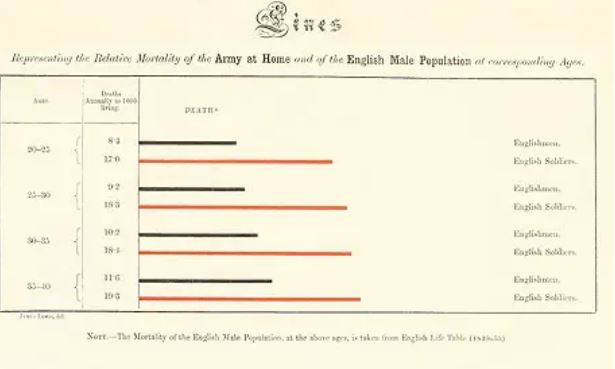
Here’s another chart created by Nightingale:
Hugh Small comments on the ways in which this chart is designed for maximum emotional impact:
The title ‘Lines’ (in ornate script in the original) makes it sound like a poem, as in Lines on the Death of Bismarck. There are four pairs of bars, when actually the message is clear from one pair alone. There seems to be a kind of repetition, as in a chorus. This effect is increased by the words, repeated at the end of each line, English Men, English Soldiers … It sounds like a funeral march. Second, the red bar for the soldiers would certainly make some people think of the ‘Thin Red Line’ which had become famous in the Crimean War when a two-deep row of red-jacketed British infantrymen stopped a Russian heavy cavalry charge, something that was thought to be impossible. The thin red lines on Nightingale’s chart represented these same heroic soldiers who were now dying unnecessarily because of bad hygiene in their barracks.
The variation of death rates due to differences in hygiene was very important to reformers like Nightingale because it showed that even the civilian death rate could probably also be improved by better hygiene.
Her goal with these charts was not just to inform, but to change hearts and minds.
In our time
In recent weeks, a number of temporary field hospitals have sprung up across Britain for the treatment of COVID-19 patients. Named “Nightingale Hospitals,” they pay homage to the famous “lady of the lamp.” Florence Nightingale’s pioneering approach to sanitation changed the understanding of public health in Victorian Britain and laid the foundations for the profession of nursing as we know it.
In our time of “mask deniers” and people who doubt the safety of vaccinations, or even that the pandemic is “real” and not a “Plandemic“, we need the persuasive power of modern-day Nightingales more than ever.
An astounding reading of Tennyson’s poem ‘Ring out, wild bells’ by actress June Spencer (aka Peggy Woolley on BBC Radio’s The Archers) sent me to the words of this 19th century poem.
Ring out, wild bells, to the wild sky, The flying cloud, the frosty light: The year is dying in the night; Ring out, wild bells, and let him die.
Ring out the old, ring in the new, Ring, happy bells, across the snow: The year is going, let him go; Ring out the false, ring in the true.
Ring out the grief that saps the mind For those that here we see no more; Ring out the feud of rich and poor, Ring in redress to all mankind.
Ring out a slowly dying cause, And ancient forms of party strife; Ring in the nobler modes of life, With sweeter manners, purer laws.
Ring out the want, the care, the sin, The faithless coldness of the times; Ring out, ring out my mournful rhymes But ring the fuller minstrel in.
Ring out false pride in place and blood, The civic slander and the spite; Ring in the love of truth and right, Ring in the common love of good.
Ring out old shapes of foul disease; Ring out the narrowing lust of gold; Ring out the thousand wars of old, Ring in the thousand years of peace.
Ring in the valiant man and free, The larger heart, the kindlier hand; Ring out the darkness of the land, Ring in the Christ that is to be.
Perhaps every generation since this was first published in 1850 have found allusions to their own era. Certainly these were suitable words to mark the beginnings of 1919 an 1946, when many would have felt the “grief that saps the mind/For those that here we see no more” as two World Wars ended.
The relevance to the start of 2021, with hope for a better year to come, especially in the United States, seems clear:
As the COVID-19 pandemic rages on:
Ring out the grief that saps the mind For those that here we see no more;
As Democrats and Republicans stare across the aisles of Congress:
Ring out a slowly dying cause, And ancient forms of party strife;
As lines of cars snake for miles around food banks across the country:
Ring out the want, the care, the sin, The faithless coldness of the times;
As Trump prepares to leave office:
Ring out false pride in place and blood, The civic slander and the spite;
As the vaccine becomes available:
Ring out old shapes of foul disease;
As Joe Biden and Kamala Harris prepare to take office:
Ring in the valiant man and free, The larger heart, the kindlier hand;
Obfuscation is alive and well in the corporate world. Molly Young writes in New York Magazine about the ways the Millenial generation of white-collar workers replicate the communication patterns of the organization man and woman.
Silicon Valley
She reviews Anna Weiners’ memoir Uncanny Valley about life in San Francisco during the current tech bubble:
…the scent of moneyed Bay Area in the mid-2010s: kombucha, office dog, freshly unwrapped USB cable…the lofty ambitions of her company, its cushy amenities, the casual misogyny that surrounds her like a cloud of gnats.
Wiener describes watching her peers attend silent-meditation retreats, take LSD, discuss Stoicism, and practice Reiki at parties. She tries ecstatic dance, gulps nootropics, and accepts a “cautious, fully-clothed back massage” from her company’s in-house masseuse. She encounters a man who self-identifies as a Japanese raccoon dog.
Only, as they say, in San Francisco. Or is it? Her description of the language employed is universal:
People used a sort of nonlanguage, which was neither beautiful nor especially efficient: a mash-up of business-speak with athletic and wartime metaphors, inflated with self-importance. Calls to action; front lines and trenches; blitzscaling. Companies didn’t fail, they died.
Weiner’s term for this is garbage language. More accurate than jargon or buzzwords since it is produced mindlessly and stinks. She notes how these terms warp and impede language, and permeate “the ways we think of our jobs and shapes our identities as workers.”
Etymology
Down the years, Weiner notes, garbage language has taken different forms:
In the 1980s it smelled of Wall Street: leverage, stakeholder, value-add.
The rise of high-tech introduced computing and gaming metaphors: bandwidth, hack, the concept of double-clicking on something, of talking off-line.
In the 1990s Clayton Christensen introduced the term disruptive.
By the turn of the century, New Age terms arrived: lean-in, conscious choices.
Then there are aviation terms: holding-pattern, discussing something at the 30,000-foot level.
Further characteristics include:
…verbs and adjectives shoved into nounhood (ask, win, fail, refresh, regroup, creative, sync, touchbase), nouns shoved into verbhood (whiteboard, bucket), and a heap of nonwords that, through force of repetition, became wordlike (complexify, co-execute, replatform, shareability, directionality).
WeWork
Young takes the WeWork SEC prospectus to task for it’s “fidelity to incoherence” — a 200,000-word tomb that overflows with windy passages such as:
We are a community company committed to maximum global impact. Our mission is to elevate the world’s consciousness. We have built a worldwide platform that supports growth, shared experiences and true success.
Why CEOs speak like idiots
In a passage worth quoting at length, Young zeros in on the dilemma those in the C-Suite face:
Edith Wharton[wrote a] story where a character observes the constraints of speaking a foreign tongue: “Don’t you know how, in talking a foreign language, even fluently, one says half the time, not what one wants to, but what one can?” To put it another way: Do CEOs act like jerks because they are jerks, or because the language of management will create a jerk of anyone eventually? If garbage language is a form of self-marketing, then a CEO must find it especially tempting to conceal the unpleasant parts of his or her job — the necessary whip-cracking — in a pile of verbal fluff.
Author Jessica Helfand lists commonly abused words and phrases, which she claims younger workers cling to because they give the illusion of authority. She classifies them as:
A mobile army of metaphors, metonyms, and anthropomorphisms — in short, a sum of human relations which have been enhanced, transposed, and embellished poetically and rhetorically, and which after long use seem firm, canonical, and obligatory to a people: truths are illusions about which one has forgotten that this is what they are; metaphors which are worn out and without sensuous power; coins which have lost their pictures and now matter only as metal, no longer as coins.
The German philosopher made the ironic suggestion that we drop all pretense at ‘functional’ speak and resort to poetry. Something, Young concludes, that would be less of a threat than the garbage spoken in the corporate world today, where:
The meaningful threat of garbage language — the reason it is not just annoying but malevolent — is that it confirms delusion as an asset in the workplace.