As I’ve previously noted, the late author Leonard Shlain has written several insightful books that examine how literacy reconfigured the human brain and brought about profound changes in history, religion, and gender relations. I was especially impressed by his analysis of the impact of the alphabet. I wrote a letter to the Financial Times in response to historian Josephine Quinn’s essay The Civilization Myth, which also identified the revolutionary impact of adopting the alphabet on Western culture:
… the arrival of the alphabet was more revolutionary than it may sound. It is apparently more natural for humans to record syllables than individual sounds…Reading and writing in one’s own spoken tongue may seem natural today, especially to English speakers. But for many it is a relatively recent choice, and in antiquity it was unusual…Literacy was a niche skill, learnt with great labor and only by scribes, until the inventors of the alphabet devised a neat trick. Each of their “letters” was originally a little picture, signalling for them the first sound of the word for the item depicted. So the sign for “a” was the head of a bull, “alef” in the Levantine language, “b” was a schematic house or “bet”, and so on. Because the signs represented sounds, not syllables, there were far fewer of them. And you didn’t actually have to learn them anyway: you just needed to know the language, and the trick.
The myth of civilizations
Quinn couched these comments in the broader context of superficially pluralistic “myth of civilization”, where Putin sees Russia as an “original civilization-state”; Chinese premier Xi Jinping has launched a new Global Civilization Initiative, to celebrate the world’s “unique and long civilizations . . . transcending time and space”. Meanwhile
Everyone is worried about the west. For some it is under attack, from refugees, terrorists or wokery. For others the west is itself the problem, forever imposing its own values as a universal good. But no one is sure what it actually is — or rather, where it stops.
She takes issue with scholars who promote the idea of distinct civilizations, “Western,” “Orthodox,” and “Islamic,” with these having roots in the ancient world of Greek and Roman civilizations.
Civilizational thinking of this kind depends on an idea of separate cultures growing like individual trees in a forest, with their own roots and branches distinct from those of their neighbors. They emerge, flourish and decline, and they do so largely alone.
The truth, Quinn argues, is that this view of distinct civilizations is “a modern confection, invented by 19th-century scholars to emphasize the superiority of their own nations and the justice of their empires.”
She sees the interaction between cultures as a critical driver of human social development:
Local and regional cultures come and go, but they are created and sustained by interaction. The encounters involved don’t have to be friendly. But it is those connections that drive historical change, from the boats that brought the African donkey and the Eurasian wheel to the Aegean in the third millennium BCE to the ships equipped with the Chinese compass that brought Europeans to the Americas 4,000 years later, to conquer them with Chinese gunpowder.
Angry White Men
Quinn concludes her essay by debunking the anti-immigration, white nationalism of the emerging authoritarians:
First promoted by the French activist Renaud Camus in his 2011 book Le Grand Remplacement, the theory that the white or indigenous European population is being replaced by immigrants in a form of reverse-colonisation is now a staple of rightwing conspiracy theorists, white supremacists and mass shooters around the world. This poisonous rhetoric depends heavily on the idea of a distinct civilization — French, British, western or white — that is under threat from different and alien cultures and especially from their children.
But it’s the idea of civilization itself that is the real problem, and in particular the notion that it is a zero-sum game, with higher cultures under threat from migrant, fecund foreign values. There has never been a pure western culture that is now under threat of pollution. No single people is an island, unless they’ve been there for a very long time and haven’t invented boats. And that’s a good thing: without new relationships between different people exchanging unfamiliar ideas, nothing much would ever happen at all.
Letter to the Editor
My one complaint with the FT is that the sub-editor who chose the title for my letter misinterprets Shlain. Literacy in the ancient world (the arrival of the alphabet) is precisely NOT like the internet for us. Better would be a title like ‘Rewiring brains for a return to feminine values.’
Another week, another article on American economic exceptionalism. In the Weekend Financial Times (subscription required) statistician John Burn-Murdoch highlights two sides to the American dream — extreme wealth coexisting with extreme poverty. Core beliefs are involved.
Data show that Americans see themselves as more upwardly mobile than people from other western countries (in reality the inverse is true), and are more likely to say hard work is essential for getting ahead in life. These are aspirational, meritocratic beliefs, but the flip side is that Americans are also the most likely to say low-income people need to pull themselves up by their bootstraps.
This is coupled with a distrust of government, and in particular their belief that government is inefficient.
While Americans are the most likely to say income inequality in their country is unfair, fewer than half see this as the government’s responsibility to address. This compares with two-thirds or more in the UK, France and Germany. Where other societies see inequality as something that is done to people and must be tackled by helping them, Americans see it as something that people are responsible for themselves.
This generates tensions within US society — where a culture of aspiration and individualism that drives entrepreneurial wealth generation, also appears to engender apathy towards inequality and especially towards government intervention, leaving the poorest to fend for themselves.
A not-so-surprising report in the New York Times highlights the fact that America spends more per capita than any other country on the planet on health care, for worse outcomes.
According to these statistics, my peers born in 1952 have just over seven years left to enjoy life in the US of A. What kind of life many will have in their final, not-so-golden, years depends on how much they can afford to spend on elder care. The Times report notes:
The main reason that U.S. health spending is so high is not that Americans are sicker than people elsewhere or are heavier users of medical care (although both those factors play a role). The main reason is that almost every form of care in the U.S. costs more: doctor’s visits, hospital stays, drug prescriptions, surgeries and more. The American health care system maximizes the profits of health care companies at the expense of families’ budgets.
A poignant example of the health care industry in the States putting profits over people is the prices charged by long-term assisted living care homes for the elderly.
These facilities can be highly profitable. “Half of operators in the business of assisted living earn returns of 20 percent or more than it costs to run the sites, an industry survey shows,” Jordan Rau, a reporter for KFF, writes. “That is far higher than the money made in most other health sectors.”
Many facilities, Jordan explains, “charge $5,000 a month or more and then layer on extra fees at every step. Residents’ bills and price lists from a dozen facilities offer a glimpse of the charges: $12 for a blood pressure check; $50 per injection (more for insulin); $93 a month to order medications from a pharmacy not used by the facility; $315 a month for daily help with an inhaler.”
The Times lays the blame squarely on the American free market economy and lack of regulation. The situation has worsened since the 1980s “That decade also happens to be when the U.S. began moving more toward a laissez-faire economy.”
I can only hope that my own life expectancy will permit me to be around for longer than seven more years. Since both my parents lived into their late nineties I hope so. If only I can afford it.
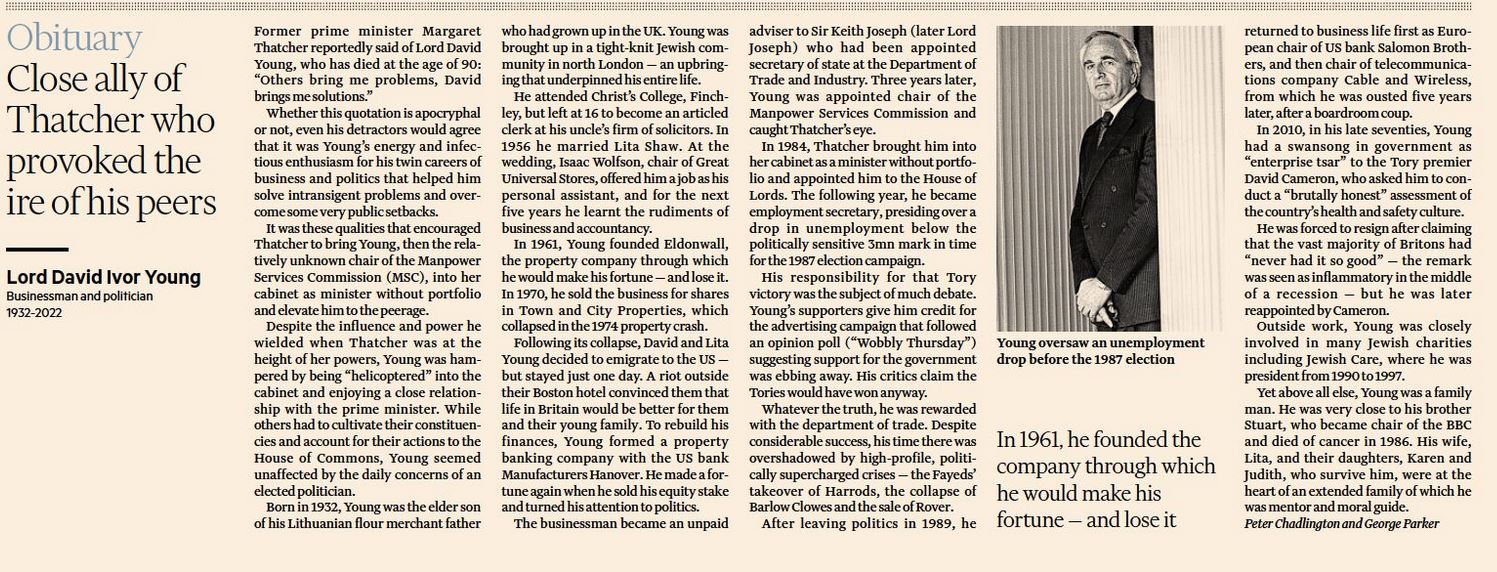
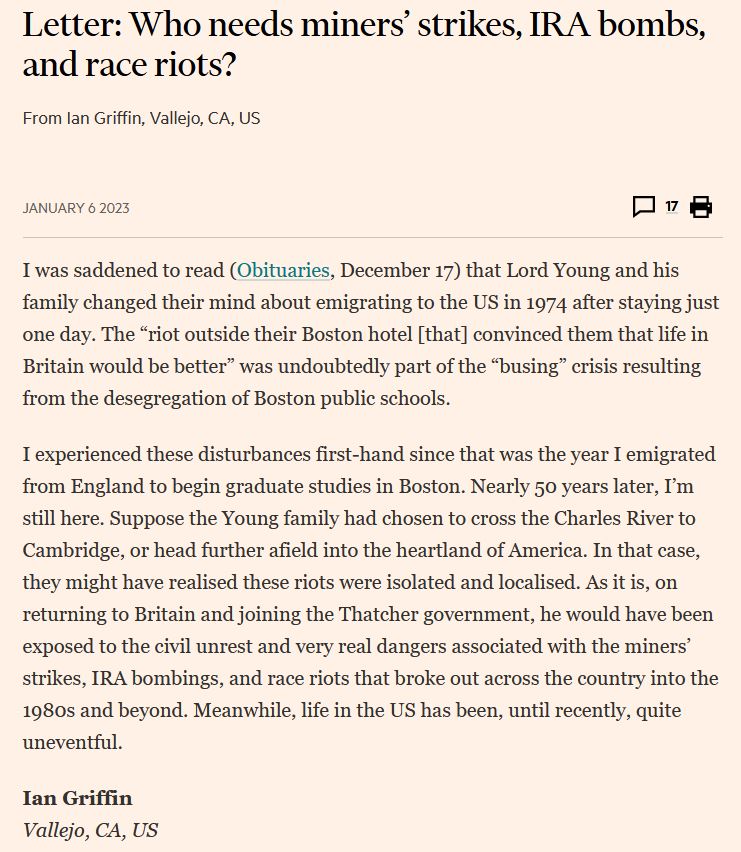
My letter to the Financial Times was printed on January 6th, 2023, in response to the December 23rd Obituary of Lord David Ivor Young.
Financial Times, Dec 17, 2022 (click to enlarge)
Over the next few days, a spirited debate arose in response to my letter on the FT website. I did not join in the discussion online, but I can clarify my intent and the background of my letter by responding to each section of the online debate.
Boston 1974
My main reason for writing (which none of the subsequent comments addressed) was the surprise I felt at the swiftness of the decision Lord (or as he was then, Mr) Young made to return to the UK after one day in Boston. And since this was precisely the time and place of my first introduction to the States, I remember the era well. I’d arrived in Boston in September to do a master’s in sociology at Tufts. Nixon had resigned that summer. Gerald Ford was president. Vietnam was winding down. The long hot summers of love and hate were well and truly over. King and the Kennedys were buried. Kent State was safe from the National Guard.
America was exhausted from the turmoil of the 1960s. Except in Boston.
There, the South Boston Irish-American community was in an uproar over the ‘forced busing’ of black kids into their schools. Southern Whites, who had become tired of being labeled racists, expressed some schadenfreude that the home state of Ted and Bobby was in racially motivated turmoil:
From September 1974 through the fall of 1976, at least 40 riots occurred in the city….On February 12, 1975, interracial fighting broke out at Hyde Park High that would last for three days with police making 14 arrests…On January 21, 1976, 1,300 black and white students fought each other at Hyde Park High, and at South Boston High on February 15, anti-busing activists organized marches under a parade permit from the Andrew Square and Broadway MBTA Red Line stations which would meet and end at South Boston High. After confusion between the marchers and the police about the parade route led marchers to attempt to walk through a police line, the marchers began throwing projectiles at the police, the marchers regrouped, and migrated to South Boston High where approximately 1,000 demonstrators engaged with police in a full riot that required the police to employ tear gas. 80 police were injured and 13 rioters were arrested…There were a number of protest incidents that turned severely violent, even resulting in deaths. In one case, attorney Theodore Landsmark was attacked and bloodied by a group of white teenagers as he exited Boston City Hall…
Extracted from https://en.wikipedia.org/wiki/Boston_desegregation_busing_crisis
I was not unaware of this, but living in Somerville, walking to Harvard Square, and catching the bus to Medford, I saw none of it. However, I foolishly persuaded some of my friends to come along to a George Wallace rally – purely out of curiosity to see American electioneering. Since we were long-haired students and clearly not from Southie, we were set on by a mob of angry white youths as we left the downtown hotel (perhaps the very hotel the Young’s stayed at). I was lucky to escape unharmed. Some of my friends were bloodied and bruised. None seriously. I remember running across to a line of police to report the attack and being met with utter indifference. It’s no surprise American visitors to Britain would remark “Aren’t your policemen wonderful!”
However, as I wrote in the letter, cross the Charles River on the Red Line to Harvard Square, and it was as peaceful as could be. As was the rest of the country, mostly.
Snap decision
So, to return to the comment in the obit that most surprised me. Having, presumably, gone to considerable lengths to secure the necessary visas to be able to emigrate to the US and paid for the flight over and the hotel, the family did not even leave the city to explore any of the nearby (peaceful) suburbs or sample the delights of Western Mass (where the turnpike might well have been covered with snow “from Stockbridge to Boston. Lord, the Berkshires seemed dream-like on account of that frostin’” as James Taylor sang). Instead, they returned to Logan Airport and flew back to London.
I can only speculate as to how that decision was arrived at. But I can well imagine his wife, Lita, seeing the mob outside the hotel window, clutching her pearls, becoming unsettled enough to demand they immediately leave.
This would not be a decision most potential immigrants to the States would take lightly. For centuries, immigration was very much a one-way ticket. Irish immigrant ancestors of the residents of South Boston would hold American wakes to acknowledge the “death” of those crossing the Atlantic. In my own case I was on a two-year student visa. When I returned to settle here permanently, I chose (as I’ve written before in this blog) to live underground as an illegal immigrant for a number of years. One can only assume the future Lord had legal immigrant status.
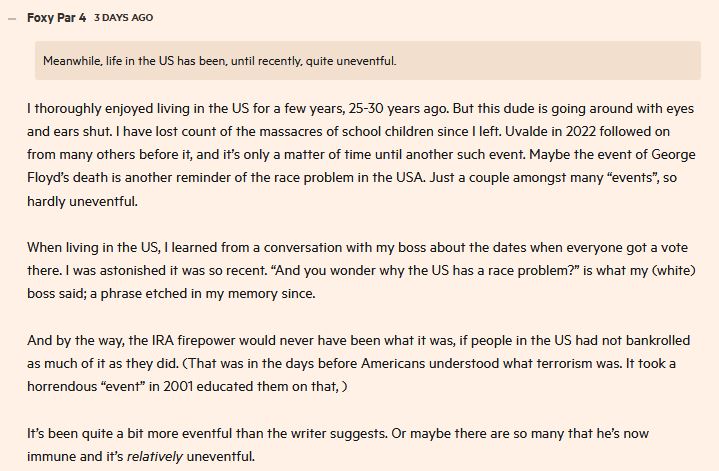
While it was a hasty decision, it was, as one person notes, to have one advantage:
Second Amendment Rights
As Foxy Par notes, America has a gun problem. This was the case in the time frame I’m addressing of the mid-1970s when the Young family caught the next plane back to London. But it has become tragically, seemingly insolubly, worse since then. The daily drumbeat of school shootings, massacres, and random acts of violence grows.
On a personal level, what is most shocking is meeting well-adjusted Americans of all political persuasions who believe the “only way to stop a bad guy with a gun is a good guy with a gun.” They’re all good guys until they’re not. I’ve worked with a senior executive I respected until he let slip that he “keeps 40 guns in the house” and was a member of the NRA. People have told me, in all seriousness, that it’s safer to live in States like Arizona, which allow “concealed carry” permits (which California does not) since the potential mugger does not know if you are “packing heat” and so leaves you alone.
John Wayne movies are seen as a script to live by.
However, in my almost 50 years here, I’ve never once seen or heard gunfire. It’s a big country of over 300 million and despite the tragic loss of life, the odds are small that any one person will be affected.
Race riots
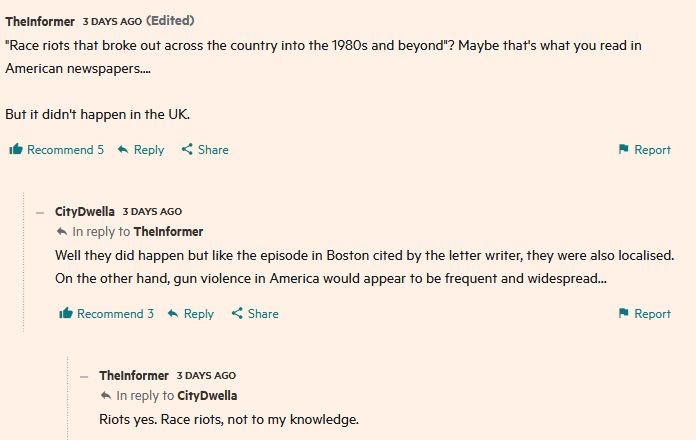
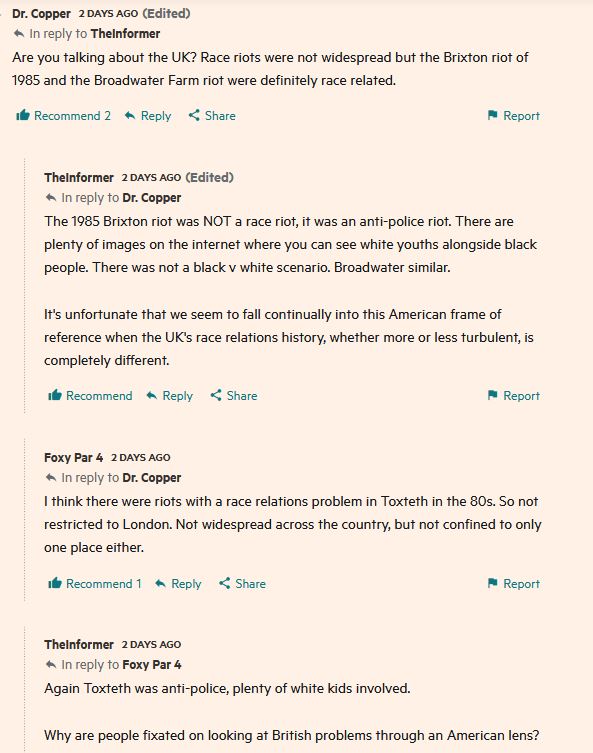
Much of the remainder of the debate was between a couple of chaps (“dudes”?) who disagreed about the racial component of civil unrest in the UK.
The Thatcher Years
The point that these commentators overlooked, and my primary response to the potential tragedy of Young’s return to Britain, is that in September 1984, he became a member of the Thatcher government.
The Brighton Hotel Tory Party Conference IRA bombing occurred the next month. Was he present when that carnage struck?
Indeed, the same year he decided that “life in Britain would be better for them,” these events happened:
On June 17th 1974, a Provisional IRA bomb exploded in Westminster Hall in the Houses of Parliament, rupturing a gas pipe and starting a fire. An IRA volunteer telephoned through a warning six minutes before the bomb exploded, allowing the area to be cleared. The warning meant that nobody was killed, though 11 people were seriously injured.
Exactly one month later, the IRA detonated two bombs in London. The first exploded near a government building in Balham shortly before dawn; there was considerable property damage but nobody was injured. Later in the day, a bomb exploded at the Tower of London in an exhibition room filled with tourists. One person was killed and 40 others were injured, some losing limbs.
These bombings led to increased security and surveillance at London landmarks, as well as an overhaul of police, emergency and bomb disposal protocols. The Provisional IRA continued to hit high profile targets in 1975, bombing Oxford Street (August 28th, seven injured), the London Hilton (September 5th, two killed and 63 injured) and Connaught Square (November 3rd, three injured).
In March 1979 (five years after he spent 24 hours watching youths misbehave in the streets of Boston), Conservative MP Airey Neave was blown up leaving the Houses of Parliament.
What did his family think of these events? Did they make life “better,” or did the very real risks that he and others in public life run in that era give them pause?
Later, the miners’ strike of 1984–1985 was a significant industrial action within the British coal industry in an attempt to prevent colliery closures that led to pitched street battles.
The strike was the most violent industrial dispute in Britain of the 20th century…Prime Minister Thatcher expected Scargill to force a confrontation, and in response she set up a defence in depth…She appointed hardliners to key positions…
Of course, on September 11, 2001, the risk equation between life in the US and UK changed radically. 67 British citizens were killed that day. Had Lord Young stayed in the States and worked in finance on the East Coast, he could have been one of them.
January 6
I closed my letter to the FT with the comment that life in the US was mostly uneventful “until recently”. I was referring, of course, to the Trump years, the events of January 6, 2001, and the polarization of political debate that was mirrored, perhaps to a lesser extent, in the debate over Brexit. It remains to be seen if we are seeing the rise of American fascism or, as happened prior to my arrival in 1974, a passing phase that will be followed by less harrowing times.
Nature
There’s also no doubt that, in terms of the potential risks from natural disasters, life is indeed riskier in the USA than the UK. I live in the San Francisco Bay Area, and it’s a case of when, not if, the Hayward Fault fractures in a major earthquake. Climate change has brought deadly torrential rains to California. We will inevitably have more wildfires. Elsewhere in the country, they deal with tornadoes and hurricanes.
Population Density
The 67 million residents of the UK are crammed into an area the size of Oregon. Since they “took back control” and separated from the EU, they are restricted to spending no more than 90 days in the Schengen Area. On a fine summer day, Cornwall and the Lake District gets somewhat crowded.
Meanwhile, 332 million residents of the US can find wide open spaces if they so desire. And while it’s not always easy to get out of the City on the weekend, there are are beautiful wilderness areas in Marin, a short drive from San Francisco.
Family
I married and raised a family in the States. I clearly remember the Fall of 1974. I was enchanted by the beauty of the foliage, enraptured by the people, and intrigued by the possibilities that lay to the West where, having read Kerouac, I longed to get On the Road.
Neither the US nor the UK has a monopoly on the good life. There are pluses and minuses to both. As a predecessor who left the north-west of England and stayed on these shores wrote:
“America is a country in which I see the most persistent idealism and the blandest of cynicism and the race is on between its vitality and its decadence.”
― Alistair Cooke
We all make life decisions that affect our futures. I’d just recommend staying for more than a day before coming to one.
I’ve just finished Anthony Doerr’s Cloud Cuckoo Land. The author of All the Light We Cannot See has crafted a delightfully complex novel that spans the centuries and features three very different libraries: the ancient, the contemporary, and the virtual. Three main characters: Anna, Zeno, and Konstance are united by the text of an ancient Greek manuscript which translates as the title of the novel.
Constantinople
Anna is a young orphan who discovers the original text in a monastery immediately before the Fall of Constantinople in 1453. The ancient, abandoned library where she finds the treasure is a “round room, partially open to the sky, that smells of mud and moss and time…on the walls of this little chamber, scarcely visible in the moonlight fog, doorless cupboards run from floor to ceiling. Some are filled with debris and moss. But others are full of books.”
Lakeport, Idaho
Fast forward to a small town in Idaho (Doerr’s home state) in 2020 and Korean war vet, Zeno Ninis–who learned Greek in a POW camp–is rehearsing five children in a play based on the Cloud Cuckoo text he has translated. They are scheduled to perform in the town library which has been his refuge since he was a child. It’s “a light-blue two-story Victorian on the corner of Lake and Park.” A confused eco-terrorist who loves owls (which feature in the Greek text) is planning to blow the library up. Like Constantinople, this library is in a state of siege.
Interstellar space
Meanwhile, some decades in the future, Konstance is a young girl living with her family as they voyage light years across time and space to an earth-like planet, leaving behind a world devastated by climate change. Zuckerberg’s “metaverse” is fully instantiated and the few dozen adults and children on the voyage live in a sealed, windowless, spaceship. They are entertained by donning VR headsets and perambulating around the sum of human knowledge hosted by the AI known as “Sybil” (as opposed to, say, HAL or Alexa). On her tenth birthday she celebrates her “Library Day” when she’s allowed, for the first time, to don a Vizer and enter the virtual world:
She stands in a vast atrium. Three tiers of bookshelves, each fifteen feet tall, served by hundreds of ladders, run for what appear to be miles down either side. Above the third tier, twin arcades of marble columns support a barrel-vaulted ceiling cut through its center by a rectangular aperture, above which fluffy clouds float through a cobalt sky…through the air, for as far as she can see, books–some as small as her hand, some as big as the mattress on which she sleeps–are flying, lifting off shelves, returning to them, some flitting like songbirds, some lumbering along like big ungainly storks.
The secrets the library on the spaceship hold are key to the eventual resolution of the various strands in the book which Doerr unlocks in a grand finale. To say more would spoil the readers enjoyment.
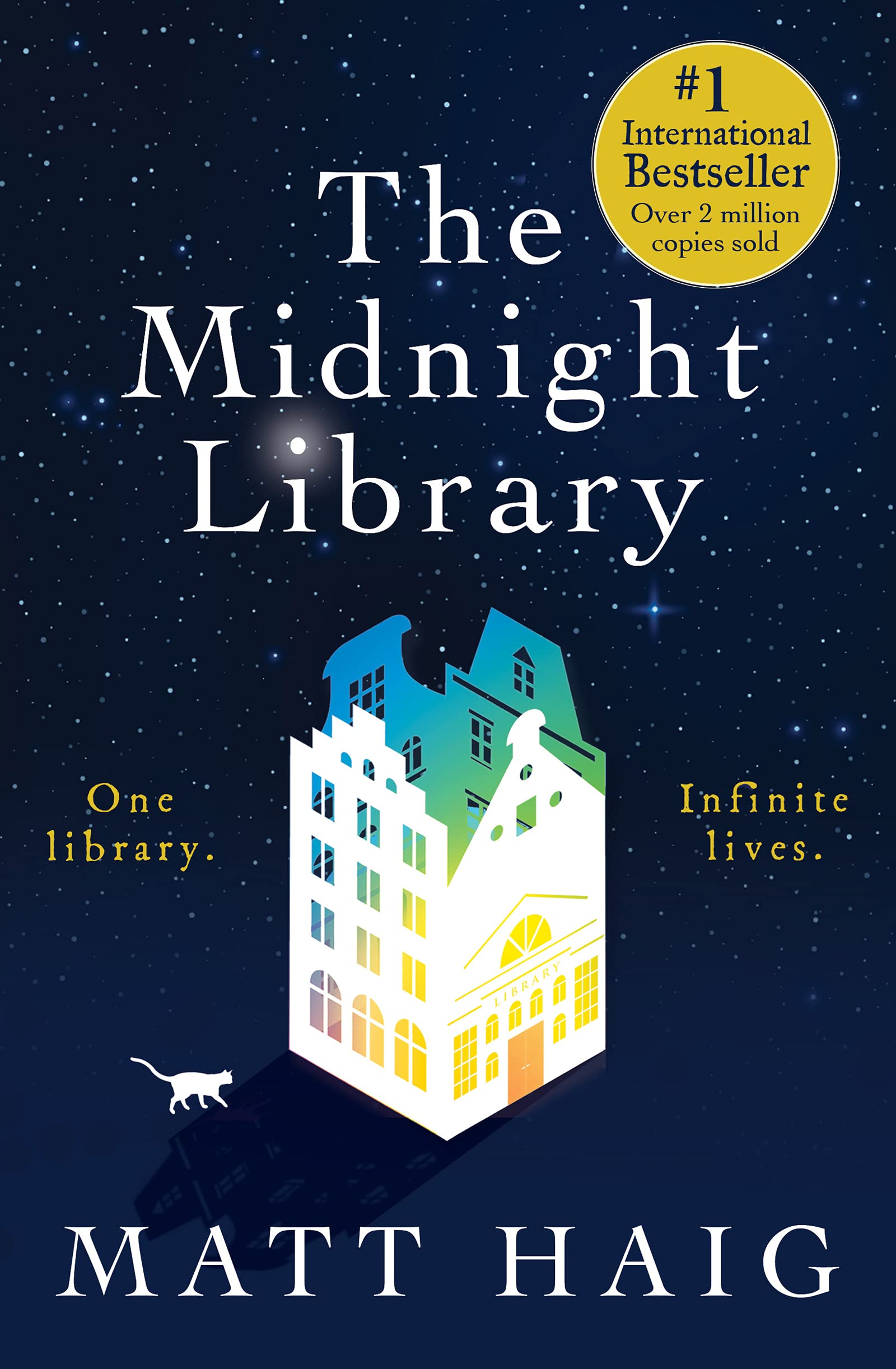
Similar to the virtual library in Cloud Cuckoo Land, Haig has written about a library that contains an infinite number of books, each one the story of another reality. One tells the story of your life as it is, along with another book for the other life you could have lived if you had made a different choice at any point in your life.
The protagonist, Nora Seed, finds herself faced with the possibility of changing her current life for a new one, following a different career, undoing old breakups, realizing her dreams of becoming a glaciologist. She must search within herself as she travels through the Midnight Library to decide what is truly fulfilling in life, and what makes it worth living in the first place.
While the virtual library in Cuckoo Land plays with the idea of a metaverse, Haig teases out the implications of a multiverse:
Between life and death there is a library…and within that library the shelves go on forever…Every life contains many millions of decisions. Some big, some small. But every time one decision is taken over another, the outcomes differ. An irreversible variation occurs, which in turn leads to further variations. These books are portals to all the lives you could be living.
Like the autonomous books in Cuckoo Land, the library Nora visits is animated:
The shelves on either side of Nora began to move. The shelves didn’t change angles, they just kept on sliding horizontally. It was possible that the shelves weren’t moving at all, but the books were, and it wasn’t obvious why or even how. There was no visible mechanism making it happen, and no sound or sight of books falling off the end – or rather the start – of the shelf. The books slid by at varying degrees of slowness, depending on the shelf they were on, but none moved fast.
The Midnight Library consoles Nora, who gradually learns to live without regret. Reviewers have noted that it gives a needed perspective at this difficult time in the world, teaches that the little things matter, and helps us learn to love being ourselves and not be influenced or concerned by how others see us.
Those who love libraries will appreciate these wonderful novels for the environments they explore and the vistas they reveal.
I wish I had a river so long I would teach my feet to fly I wish I had a river I could skate away on I made my baby cry
‘River’, Joni Mitchell
Watching Robson Green walking coast-to-coast along Hadrian’s Wall (a journey I made in September 2019) I was struck by the incongruity of him spending an afternoon fly-fishing on the River North Tyne. It’s not that he obviously did not carry a set of waders and a fishing pole in his rucksack, it was the name of the river he waded into.
Something sounded so wrong. I’ve spent too long in the States.
Why River North Tyne and not North Tyne River? I had no problem with River Tyne, River Thames, or River Avon. It was the three words in that order that jarred.
Then, a sudden realization, American’s *always* put River after the name, the British before.
It sounds equally wrong to say River Mississippi, River Columbia, or River Sacramento as it does to say Thames River,Avon River, or Tyne River. Just not, to my ears, River North Tyne.
Sacramento River (Carquinez Straights), River Tyne (nr. Wylam)
Likewise, who gets to decide when to call a watercourse The Mississppi, The Thames, or The North Tyne?
Then there’s Thamesside, Tyneside, and Humberside. But not Mississippiside, which just has one too many s’s in it.
The Banks are, however, agnostic to culture. The Banks of the Mississippi and the Banks of the Tyne both work–unlike the Royal Bank of Scotland which plainly didn’t.
Divided by a common language
Fortunately, smarter people than me have looked into why this is, even though it is, in the end, a mystery:
Once upon a time, river names in English usually included the word “of.” So instead of “River Jordan” (in modern British usage) or “Jordan River” (in American usage), you would have found “River of Jordan” (written something like “rywere of Iordane”).
Many of the Oxford English Dictionary’s earliest citations for names of rivers, dating from the late 1300s, include “of.” Chaucer in 1395, for example, wrote of “the ryuer of Gysen.”
This practice of including “of” in river names, the OED says, wasn’t the only way of naming rivers, but it was “the predominant style before the late 17th cent.”
At that point, “of” began to drop out of river names, and British and American practices started to diverge.
In proper names, the word “river” commonly came first in Britain, but last in the American Colonies. In other words, most English speakers simply dropped “of,” but Americans reversed the word order as well.
While “river” has occasionally appeared at the end in British writing, this was “uncommon,” the OED says. Most of Oxford’s citations for “river” in last place are from the mid-1600s and after, and most are from North American sources.
As things now stand, the OED explains, the word “river” appears first “chiefly in British English referring to British rivers and certain other major, historically important rivers, as the Nile, Rhine, Ganges, etc.”
In North American usage, however, “river” comes at the end except sometimes in “certain other major, historically important rivers” like the ones mentioned above.
But we haven’t addressed the question “Why?” Why does usage differ in Britain and America? Why did the Colonists prefer “James River” and “Charles River” to the reverse?
We can’t answer that. But certainly, the style adopted by the Colonists wasn’t unknown in the mother country.
(Full disclosure: Matt is the nephew of my good friend James Haig. I heard Matt speak at a recent Marin County bookstore where I purchased his book. I’ve not read any of his other writing, but see from Twitter that he has a large and loyal fan base. It was Matt who told me that he was not aware of the 2003 Pete Hamill novel on the subject of immortality and that he’d never visited Arizona before writing the book.)
How to Stop Time
I enjoyed English author Matt Haig’s latest novel How to Stop Time not only for the wonderfully evocative portrait of the many different historical periods, but for the way these are woven together into a believable whole in the protagonist Tom’s life.
Haig does this in so many ways, one example being the close of the main para on p. 325 which takes us “back down the path from where we came…as sycamore seeds spin and fall in this same forest.”
I enjoyed the focus on the interior life of the protagonist as much as the exterior events. And the subtle digs at our current crazy political situation.
While he writes stunning prose, Haig is obviously a poet at heart. The two sentences at the bottom of p.313 describing the world that remains after the death of one of the characters took my breath away.
This is a wonderful book, hugely enjoyable.
Forever
Ironically, the author claims not to be aware of Pete Hamill’s Forever: A Novel which would be a fine companion read.
There are many differences between the two novels, but they share a common theme. Hamill takes over 250 pages before his protagonist is granted a life many times longer than the usual span. Haig’s character is born with a rare condition shared by others.
Tom Hazard is free to wander the world, and one of the joys of Haig’s book is not only the way he evokes different times, but also multiple locations: Paris, the South Seas, London and New York. One of the conditions of Cormac O’Connor’s life, once he’s made into an immortal, is that he can never leave Manhattan. So he watches as New York grows from the tiny pre-Revolutionary settlement into the 21st century metropolis. The world changes around Cormac, while for Tom changes in latitudes fill the decades.
Both men have to deal with the challenge of outlasting the generations of people they live among. This begins early on for Tom when he escapes superstitious 17th Century witch-hunters and it drives him on his travels to distant lands.
Cormac is a witness to the excesses of New York: the violence, jails, brothels, plagues, Tammany Hall. Hamill relishes the tide of history that sweeps over New York, especially Irish New York.
In the modern world Tom becomes a history teacher, while Cormac tells people he’s “a kind of historian” (p. 482). Both men must be careful not to reveal too much about the past eras they in fact lived through.
Both also deal with the psychological burden of ageless living. Cormac’s “mind felt like sludge…his body felt young, and looked young, but his brain felt ancient.” (p.393) Tom Hazard suffers from debilitating headaches that mark the challenge of endless life:
“The longer you live, the harder it becomes…Forever, Emily Dickinson said, is composed of nows. But how do you inhabit the now you are in? How do you stop the ghosts of all the other nows from getting in? … The memories swell. The headaches grow.” (p. 19)
Cormac is clearly Hamill’s alter ego: an Irish-American reporter in New York. He writes about the city he knows so well, in a similar way that Woody Allen’s Manhattan is a tribute to his insider knowledge of the Big Apple.
Both authors examine the peculiar challenges of relationships with women and children who have ageless lovers and fathers. Both employ the trope of the challenge of love outlasting the passage of time:
Love’s not Time’s fool, though rosy lips and cheeks
Within his bending sickle’s compass come:
Love alters not with his brief hours and weeks,
But bears it out even to the edge of doom.
Shakespeare – Sonnet 116
Tom Hazard is a vehicle for Haig’s research into different eras and locations. He confessed to having written about Arizona (very convincingly) before ever visiting it. But there again, neither he nor Hamill visited past times, except in their imaginations.
Peter Thiel, the billionaire co-founder of PayPal, plans to live to be 120. Compared with some other tech billionaires, he doesn’t seem particularly ambitious. Dmitry Itskov, the “godfather” of the Russian Internet, says his goal is to live to 10,000; Larry Ellison, co-founder of Oracle, finds the notion of accepting mortality “incomprehensible,” and Sergey Brin, co-founder of Google, hopes to someday “cure death.” These titans of tech aren’t being ridiculous, or even vainglorious; their quests are based on real, emerging science that could fundamentally change what we know about life and about death.
“Fear of death is fear of surrender to Infinity. Learn to surrender, to exist at Infinity while alive, and fear of death dissolves. Fear of death is fear of the Unknown. Realize the Wonder, the Eternal Unknowability of the Totality of Existence, and fear of death is transcended.”
Dipping into past blog posts I came across my 2006 comments on the cultural differences between Japan, Australia and the US around attitudes toward the wealthy.
While the Japanese hammer down the nails that stick up, to enforce conformity, and the Australians whack their tall poppies, Americans are famous for their adulation of the wealthy.
In the comments to that original post I added a 2008 article by FT columnist (now Canadian Minister of Foreign Affairs) Chrystia Freeland, who detected changing attitudes to the super-rich wishing to enter politics as revealed by then-attitudes to New York Mayor Mike Bloomberg “flirting with an independent bid for the White House for months. By and large, New Yorkers have been indulgent, but this week brought a chorus of scoldings, some of them directly aimed at his extraordinary fortune.”
She concluded by speculating that the mood in the US was moving toward condemnation of the wealthy, and asks us to:
Consider Donald Trump, who has built new a career as a media celebrity by assuming the persona of an obnoxious yet somehow admirable billionaire. Now, though, the mood is changing.
Flashing for the refugees on the unarmed road of flight
— Bob Dylan, The Chimes of Freedom
As I’ve previously posted immigration, legal or otherwise, is the lifeblood of the United States. Refugees form an important source of immigrants who are often among the least understood, most victimized and yet most valuable additions to a society. Since 1975, the U.S. has resettled more than three million refugees. Consider the role of some these refugees and the way they helped make America great:
Andy Grove, Hungarian refugee, founder of Intel currently valued at $203 billion.
Jan Koum, Ukrainian refugee, founder of WhatsApp which in 2014 was purchased by Facebook for $22 billion.
Steve Jobs, the son of a Syrian refugee, co-founder of Apple, currently valued at $900 billion.
This information is from an important new report from Upwardly Global that highlights the role of refugees in America and reviews both their successes, as well as barriers to integration they face.
The foremost barrier, not surprisingly, sits in the White House. The report notes:
The U.S. refugee policy overhaul in 2017 marks a fundamental shift in how the U.S. allows people to enter the country at a time when 65.6 million people around the world have been forcibly displaced, including 22.5 million refugees. In September, the White House announced plans to cap the number of refugees the U.S. will accept in 2018 at 45,000, the lowest number since the current U.S. refugee admissions system was established in 1980.
This policy ignores the fact that accepting refugees is not only a humanitarian and legal obligation, but an investment that leads to long-term socioeconomic benefits. Investing in skilled refugee workforce integration yields tremendous benefits for our economy and communities. In 2016, Upwadly Global helped 247 refugees secure full-time professional jobs with an average income of $47,000 – resulting in these individuals lifting themselves out of poverty and become economic contributors.
Let’s not turn our back on the global need to resettle refugees. Let’s do something that will really make America great again and welcome more refugees to America!
People in Limerick like to point out that Angela’s Ashes is more a story of Frank McCourt’s life in a dysfunctional family with an alcoholic father than it is about growing up in the Ireland of the 1930s. I’d like to point out that Dan Lyons has written more of a story about one dysfunctional and bizarre company in Boston than any ‘trenchant analysis of the start-up world’ in general.
I can claim to know what I speak of, since I’ve spent my entire career in Silicon Valley and I’m a good decade older than Dan, working in a company where many, but not all, of the employees are half my age. There’s nothing remotely similar to his experiences at HubSpot in the various marketing departments I’ve worked in.
How the mighty have fallen
Perhaps because I did not come from as a rarefied an environment as he did working for Pulitzer Prize winners and interviewing Bill Gates, I’ve never been discombobulated by the generational differences that keep Dan awake at night.
Unlike Dan, I walk to work every day past the Salesforce Tower without thinking of Marc Benioff’s genitalia.
I can converse with younger workers who are the age of my own kids without feeling demeaned by the experience.
I take pride in writing blog postings and managing social media (despite my advanced age…) for the various organizations I’ve worked for.
Bursting the bubble
That said, Lyons does get it right in his broader analysis of the tech world, specifically his telling critique of the well-funded software start-ups that are currently burning through the VC’s cash with abandon. Just this morning I heard a radio program about the dozens and dozens of new companies offering Parking Apps. How many will be around a year from now? These may well become the poster children for the coming collapse of the new tech companies just as pets.com and others were for the first dot-com bust.
Ageism in the software industry
Likewise, he’s got a point about ageism in tech. After all, Mark Zukerberg did say that young people are just smarter and the thin disguise of hiring for ‘cultural fit’ often results in clones of the founders filling the cubes. But just as guilty are the recruiters for trading floors and venture capital companies.
Vaporware
At the end of the day it’s obvious that Lyons was happier vaping cannabis oil on the west coast than eating humble pie back east. He’s one of the gang on the Sony lot in Culver City working with a team that he admits engaged in ‘trading the worst poop-related stories we’ve ever heard, and pitching jokes about enormous cocks’. One can only wonder if the culture shock he experienced at HubSpot would pale in comparison to someone whose not pickled in the same journalistic brine that formed him trying to hold their own in that environment.
Perhaps the best solution would have been for him to bond over a bong with the youngsters in the start-up, ensuring a mellow time for one and all.







 I enjoyed English author Matt Haig’s latest novel
  Ironically, the author claims not to be aware of Pete Hamill’s
  Dipping into past blog posts I came across my 2006
  As I’ve
